
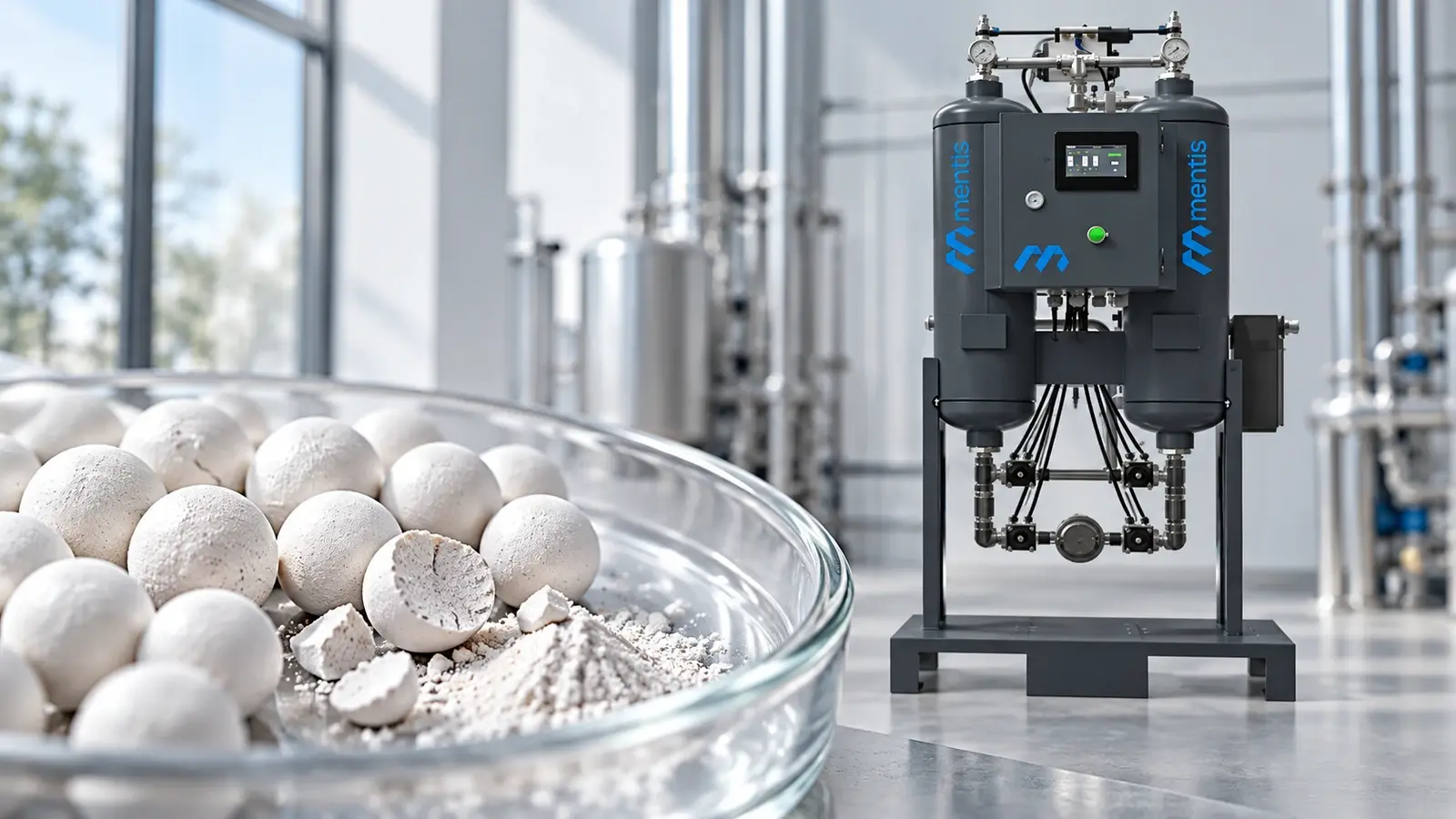
Mechanical wear of adsorbent pellets in desiccant dryers and PSA systems can generate fine particles. Yet not every downstream particle is adsorbent: pipe corrosion, installation debris or other contamination may be involved. CMS, zeolite and activated alumina are different products; colour or appearance alone cannot establish the source.
Service assessment should consider loading and transport history, bed conditions that may permit pellet movement, and support and retaining components. Changes in pressure cycling and flow outside design conditions also deserve review. Oil and liquid-water carryover create a separate contamination risk; a purity or dew-point problem should not automatically be attributed to mechanical dusting.
Record faster outlet-filter loading, increasing differential pressure at the same flow, changes in exhaust performance and product-quality deviations together. One high differential-pressure reading does not prove that the bed is exhausted; filter sizing, actual flow and other contaminants influence it. Limited initial dust after commissioning and a continuously rising particle load are different situations; apply the manufacturer's acceptance criteria.
Provide model and serial number, running hours, adsorbent type, last replacement date, filter replacement frequency and pressure/quality trends. Sampling and internal inspection require competent service personnel after isolation and verification of depressurisation. Control dust exposure according to the adsorbent safety data sheet. Removing the outlet filter, mixing adsorbents or adding unplanned top-up material does not resolve the underlying cause.
Review adsorbent condition, filtration and cycle records together with Mentis Engineering. Support your maintenance enquiry with observed changes so the service scope can be defined correctly.