
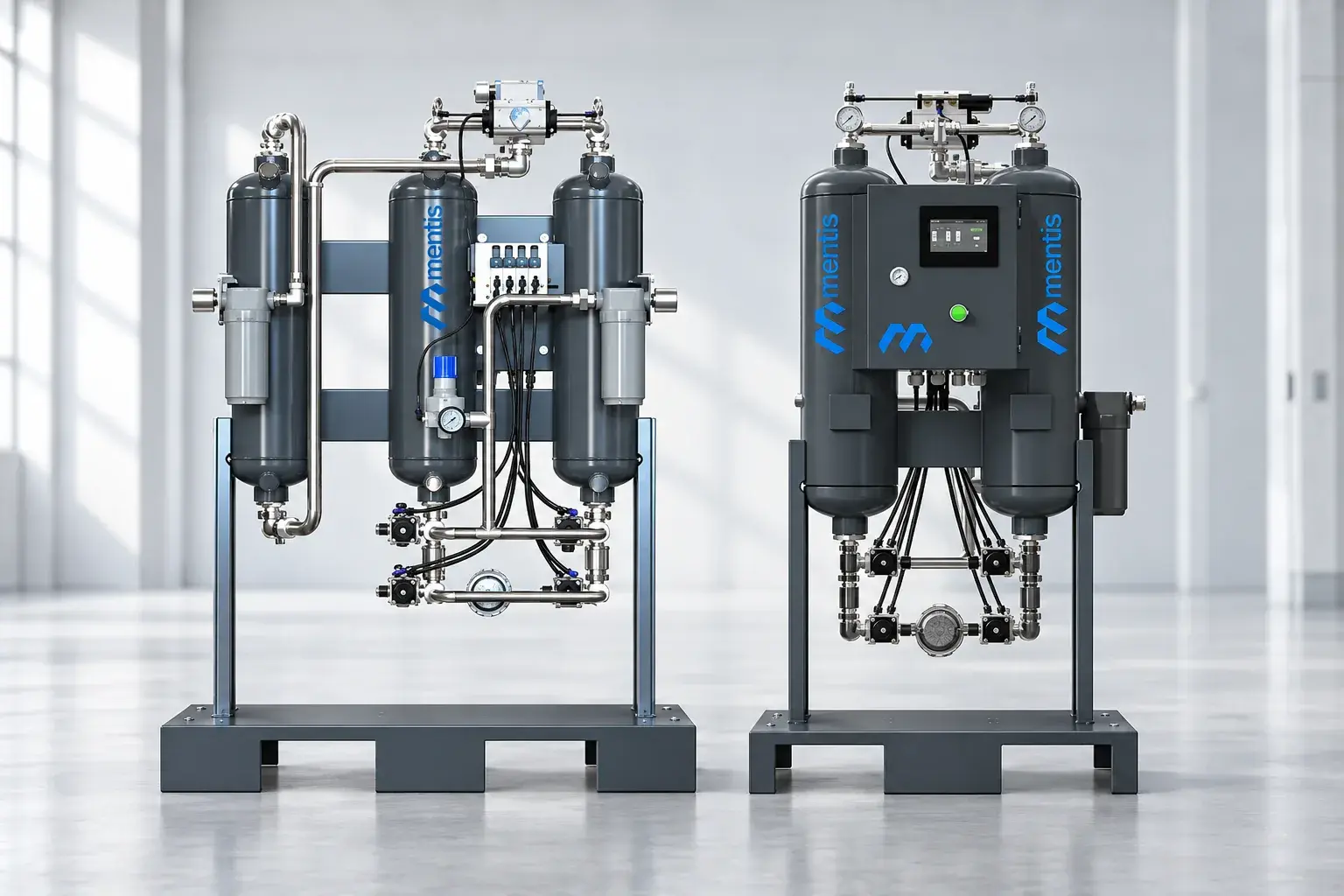
Desiccant dryers remove water vapour from compressed air by adsorption; activated carbon towers adsorb oil vapour and selected hydrocarbons. Correctly sized together, they provide controlled air treatment for production processes sensitive to moisture and oil contamination.
Also called adsorption dryers, these systems retain water molecules on the surface of porous media such as activated alumina or molecular sieve. The process relies on adsorption rather than chemical dosing into the air. In a twin-tower arrangement, one bed dries while the other regenerates. Heatless units use dry purge air; heated and blower-assisted designs offer different balances between electrical demand and compressed-air consumption.
Pressure dew point (PDP) is the temperature at which condensation begins at line pressure; it is not the outlet air temperature. The water thresholds below follow ISO 8573-1 classification, as explained in the CAGI compressed-air purity guide.
| Target PDP | Water class | Selection approach |
|---|---|---|
| ≤ −40 °C | Class 2 | Industrial processes requiring low moisture |
| ≤ −70 °C | Class 1 | Critical processes with stricter moisture limits |
Particle and oil classes must be specified separately. PDP alone does not demonstrate a complete compressed-air purity class.
Coalescing filters reduce liquid and aerosol contamination; activated carbon provides the oil-vapour adsorption stage. A carbon tower does not replace drying or upstream filtration. Humidity, inlet temperature and hydrocarbon loading affect service life. Approaching carbon saturation may not produce a corresponding rise in pressure drop, so replacement planning should use manufacturer data and air-quality measurements.
An example arrangement comprises an aftercooler and water separator, suitable prefilters/coalescing filters, an adsorption dryer, a dust afterfilter, an activated carbon tower and, where required, a downstream carbon-dust filter. Confirm the final sequence against the equipment manufacturer's design. Refrigerated predrying should be evaluated against inlet moisture load and energy requirements.
Applications include painting and coating, instrumentation, electronics manufacturing, laser processes with defined air-quality requirements, and PSA generator feed air. Food and pharmaceutical applications require additional definition of hygiene requirements at the point of use.
Mentis offers separate equipment and desiccant dryers with integrated activated carbon towers. Select −40 °C or optional −70 °C PDP according to the application. Send your flow, pressure, inlet temperature and target air quality to info@mentiseng.com for an engineering review of equipment and operating conditions.