
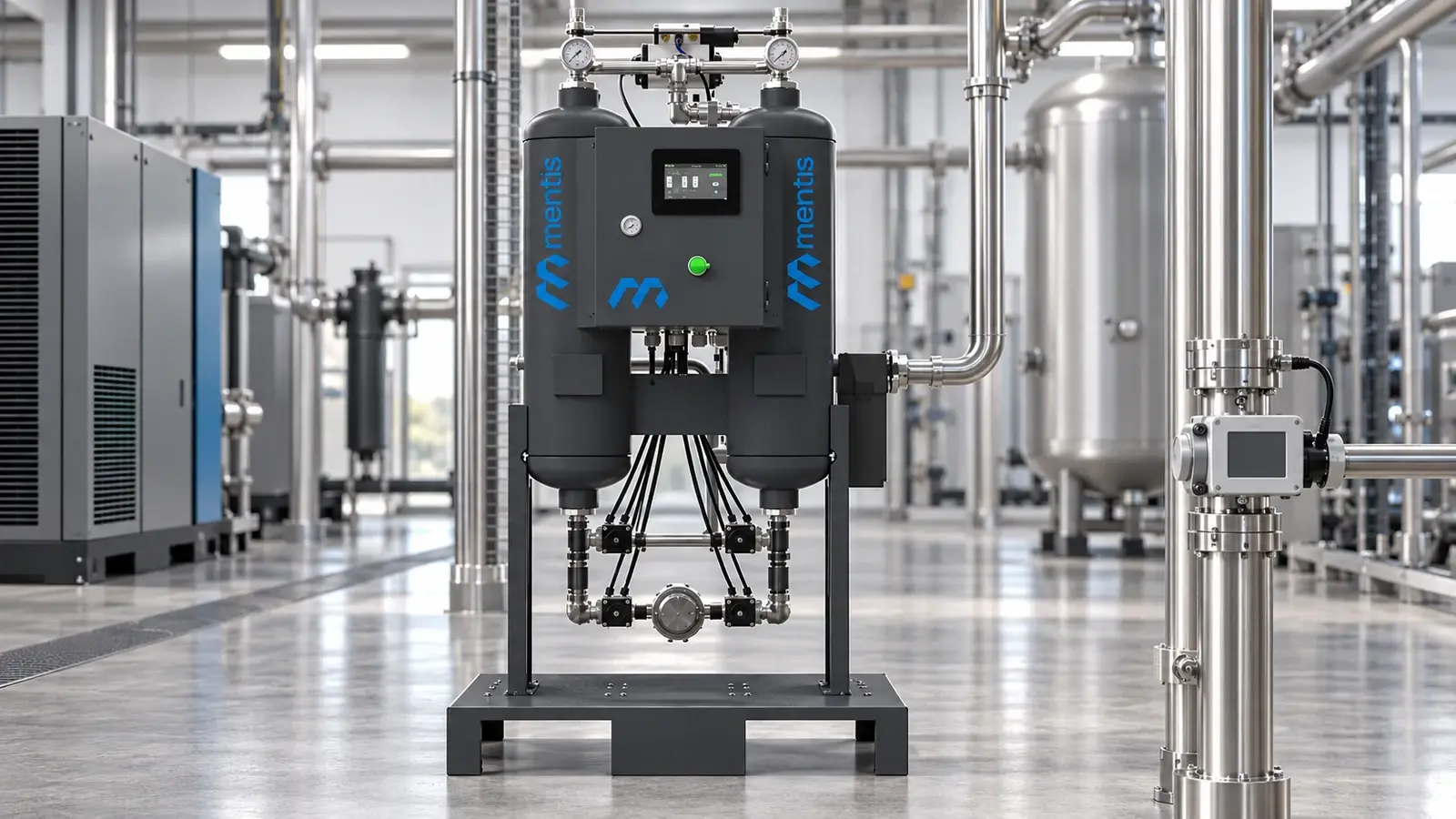
A heatless desiccant dryer uses part of its dried air to regenerate the adsorbent. Consequently, its published inlet capacity may differ from the net dry-air flow delivered to the process.
Check whether the manufacturer's figure describes inlet flow or net delivery. A purge percentage based on inlet flow, rated capacity or another reference has different implications. Express all flows at the same reference temperature, absolute pressure and moisture basis.
Divide regeneration-air volume over a complete cycle by cycle duration to obtain average flow. Check how the manufacturer's calculation accounts for purge, depressurization, repressurization and pilot air. Do not count the same volume twice. Dew-point-dependent controls also require a representative load profile.
For illustration only, an inlet of 1,000 Nm³/h and total average dryer air consumption of 150 Nm³/h leave 850 Nm³/h net, at identical reference conditions. If consumption is defined as 15% of inlet flow, a 1,000 Nm³/h net requirement needs 1,000 / 0.85 ≈ 1,176.5 Nm³/h inlet. This percentage is not a Mentis product specification.
Consider inlet temperature, minimum pressure, moisture load, target pressure dew point and manufacturer correction factors together. Arbitrarily reducing regeneration settings to save air can compromise drying. Compressor and receiver sizing must also cover instantaneous requirements. Share your net-air demand and site conditions with Mentis to assess the appropriate dryer capacity.