
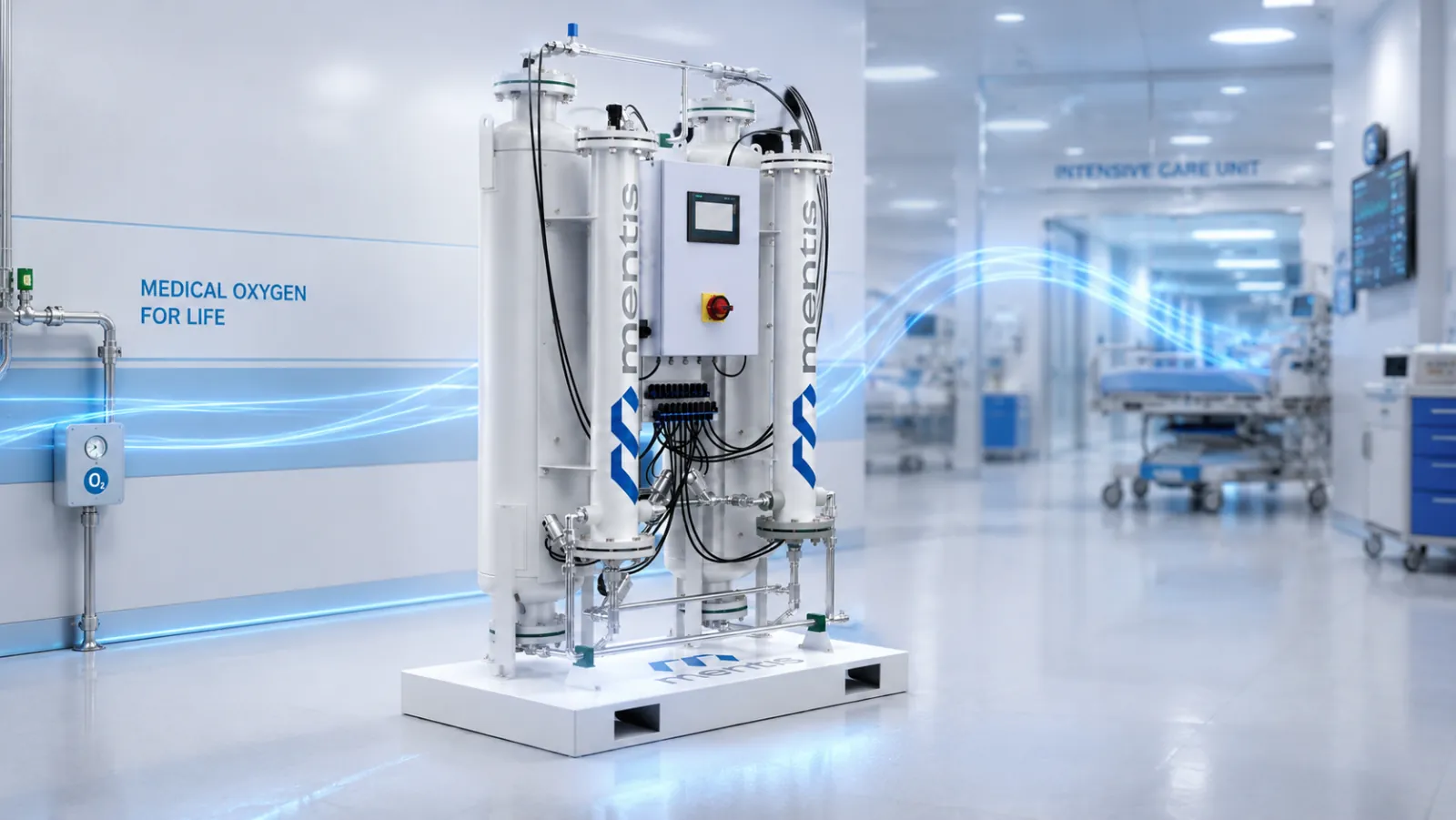
Oxygen is widely used in intensive care units, operating theatres, emergency departments, neonatal and pediatric units, respiratory therapy and many other clinical applications.
For this reason, a hospital oxygen system must provide more than adequate flow.
It should also ensure:
Medical oxygen is not an ordinary industrial utility. It is a life-support infrastructure.
PSA stands for Pressure Swing Adsorption.
Atmospheric air contains approximately 21% oxygen and 78% nitrogen. In a PSA oxygen generator, compressed and conditioned air passes through adsorption vessels containing Zeolite Molecular Sieve – ZMS.
The zeolite preferentially adsorbs nitrogen, allowing an oxygen-enriched product gas to leave the generator.
A typical hospital system may include:
Air Compressor → Air Receiver → Filtration and Drying → PSA Oxygen Generator → Oxygen Receiver → O₂ Analysis → Medical Gas Pipeline
Two adsorption vessels operate alternately, allowing continuous oxygen production.
Oxygen 93 is the terminology commonly used for medical oxygen produced by PSA technology.
In medical PSA applications, oxygen concentration is typically within approximately 90–96% O₂ by volume, subject to the applicable pharmacopoeia, national regulations and medical gas requirements.
The critical point is not oxygen concentration alone.
The complete system must also address gas quality, contamination control, pressure, monitoring, alarms and supply continuity.
Traditional hospital oxygen supply may rely on:
With PSA technology, the primary raw material is atmospheric air.
Oxygen is generated directly at the hospital, which can significantly reduce operational dependence on tanker and cylinder deliveries.
This can be particularly valuable for:
A medical oxygen system should not be sized only according to the number of beds.
Engineering should consider:
The difference between average and peak oxygen consumption can be substantial.
For this reason, Mentis Engineering evaluates the actual demand profile and critical operating scenarios, not only daily Nm³ consumption.
A hospital cannot treat oxygen interruption as a normal production shutdown.
A properly engineered medical gas system therefore requires an independent reserve or emergency oxygen source.
Depending on the project, configurations may include:
PSA + PSA + Cylinder Manifold
or
PSA + LOX Backup
For larger facilities, modular or N+1 redundancy can be considered so that oxygen supply can continue even during maintenance or equipment failure.
Medical PSA oxygen quality should not be checked only during commissioning.
Depending on the system architecture, online instrumentation and automation can continuously monitor:
If gas quality or system parameters move outside defined limits, the control system should activate the appropriate alarm and safety logic.
| Criterion | PSA On-Site Generation | Liquid Oxygen – LOX |
|---|---|---|
| Oxygen source | Atmospheric air | External gas plant |
| Production | At hospital | Off site |
| Tanker dependence | Low | High |
| Electricity requirement | Required | Lower at site |
| Cryogenic storage tank | Not required | Required |
| Continuous gas purchasing | Reduced | Required |
| Expansion | Modular | Larger storage/delivery capacity |
| Main OPEX | Electricity + maintenance | Gas + logistics |
| Main dependency | Power + equipment | External supply chain |
The objective is not to claim that PSA replaces LOX in every hospital.
For some large healthcare facilities, a strong architecture may be:
PSA = Main Oxygen Source
LOX or Cylinder System = Backup / Emergency Source
LOX and cylinder oxygen costs can include more than the gas itself:
oxygen purchase + transportation + storage + tank/manifold infrastructure + logistics + supply management
PSA operating costs mainly consist of:
electricity + compressor operation + maintenance + filters + consumables
For high-consumption hospitals operating 24/7, the correct comparison should be made on the basis of:
cost per Nm³ of usable medical oxygen
rather than only the equipment purchase price.
Mentis Engineering approaches medical PSA projects as complete oxygen-generation infrastructures.
We evaluate:
**Compressed Air Production
Our objective is not simply to generate oxygen.
It is to engineer a reliable, monitored, energy-conscious and continuity-focused medical oxygen system according to the hospital's actual demand.
For Mentis Engineering, medical oxygen generation is not only about purity, flow and pressure.
It is also about supply security and system engineering.
PSA technology allows hospitals to generate medical oxygen directly on site from atmospheric air.
When properly engineered, on-site production can:
Mentis Engineering considers PSA oxygen generation a core part of the hospital's critical medical gas infrastructure—not simply a standalone machine.
Share your hospital's oxygen consumption, bed capacity, peak demand and current LOX or cylinder costs with Mentis Engineering to evaluate the appropriate PSA capacity and on-site oxygen feasibility.
Mentis Engineering – On-Site Medical Oxygen Generation