
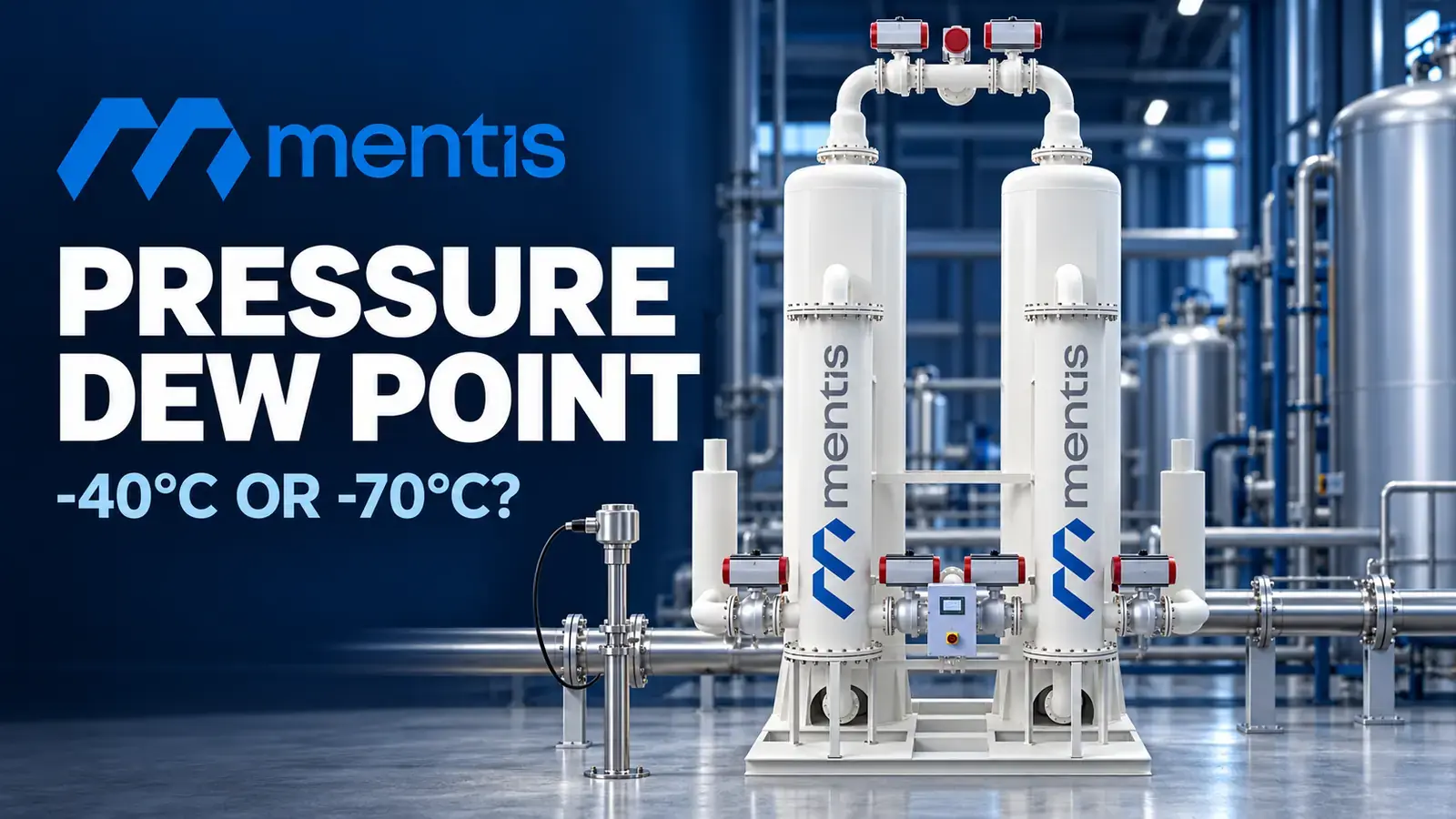
Pressure dew-point targets of −40 °C and −70 °C address different moisture requirements. The appropriate choice depends on the process specification and distribution conditions. A lower value means less water vapour at the same measurement pressure, but every application does not require the same drying level.
Pressure dew point identifies the temperature at which moisture begins to condense at a stated gas pressure. It cannot be compared directly with a sample expanded to atmospheric pressure. Specify the target temperature, measurement pressure and sampling conditions together when requesting and comparing dryer proposals.
−40 °C is considered for many industrial drying duties; −70 °C is evaluated where lower residual moisture is needed. Do not select solely by industry label. Assess product sensitivity, equipment supplier limits and the lowest temperature the distribution system will encounter under its operating conditions.
Select drying alongside particle and oil control. ISO 8573-1 treats these contaminants as separate elements of compressed-air quality. A low dew point alone does not establish oil-free, particle-free or sterile air. Define the complete quality requirements of the actual process and its critical use points.
Flow, inlet temperature and pressure affect the dryer's moisture load. Summer conditions, compressor cooling and upstream separation belong in the selection calculation. Verify catalogue capacity against actual inlet conditions. Check drainage and pretreatment arrangements that prevent liquid water carrying over into the adsorbent bed.
Activated alumina, molecular sieve and appropriate layered beds serve different duties. Changing the filling alone may not achieve a lower target. Bed quantity, cycle timing, regeneration air and heating arrangements must be considered together. Include the cost of producing purge air in the overall energy comparison.
Monitor both dryer outlet and critical use points. Measuring range, sample flow, calibration and sensor placement matter. Evaluate readings during regeneration changeovers and high loads. Request records showing specification compliance throughout stable operation rather than relying on one exceptionally low spot measurement.
Send Mentis your air flow, operating pressure, inlet temperature, application and required dew point. We can evaluate −40 °C and −70 °C options against your real conditions. Request a technical proposal combining the appropriate desiccant dryer, filtration and dew-point monitoring equipment.