
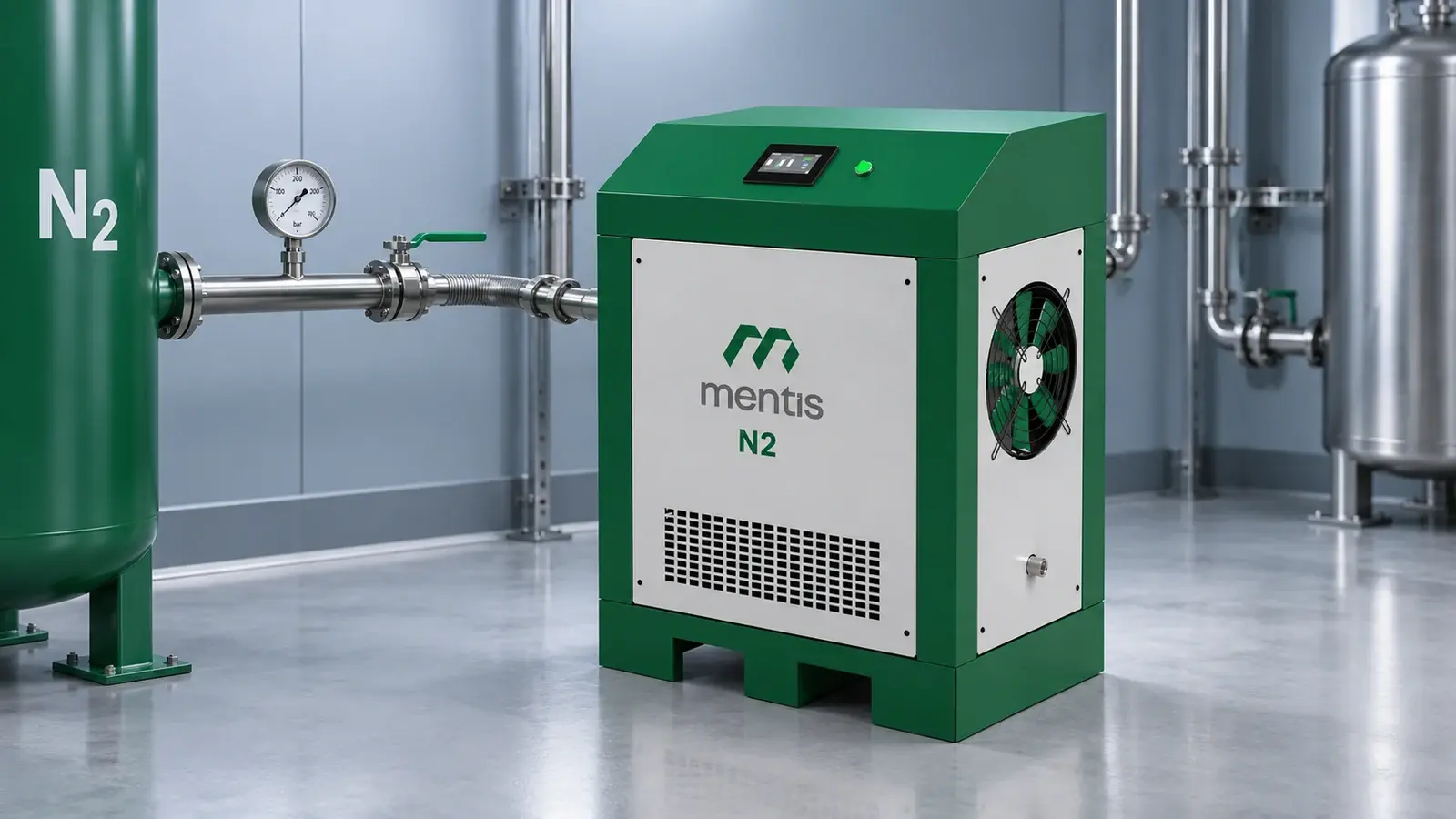
Reaching the target discharge pressure does not prove that a nitrogen booster can continuously deliver the required flow at that pressure. Selection must consider inlet and outlet conditions at the same operating point.
Record the minimum pressure at the booster inlet while it operates, rather than the receiver pressure at rest. Pipework, filters and regulators can make this different from the generator display. Record gas temperature and the demand profile alongside pressure.
For a reciprocating machine at comparable speed and volumetric efficiency, suction gas density affects the quantity transferred per stroke. Density depends on absolute pressure, absolute temperature and compressibility. Actual m³/h and Nm³/h therefore cannot be compared directly. Applying a fixed percentage capacity correction for an inlet pressure change is also unreliable.
Compression ratio uses absolute discharge pressure divided by absolute inlet pressure. A lower inlet pressure increases this ratio for the same outlet pressure, making valve behavior, temperature, cooling and drive limits relevant. Electric, hydraulic and pneumatic boosters have different characteristics. Use the selected model's manufacturer curve, permitted inlet range and duty cycle.
A booster does not generate nitrogen. If continuous withdrawal exceeds available generator flow, an intermediate receiver offers only temporary balancing. Never disable low inlet pressure protection; qualified personnel should assess settings using the manufacturer's procedure. Share your generator model, minimum inlet pressure, target discharge and Nm³/h demand with Mentis to evaluate a suitable combination.