
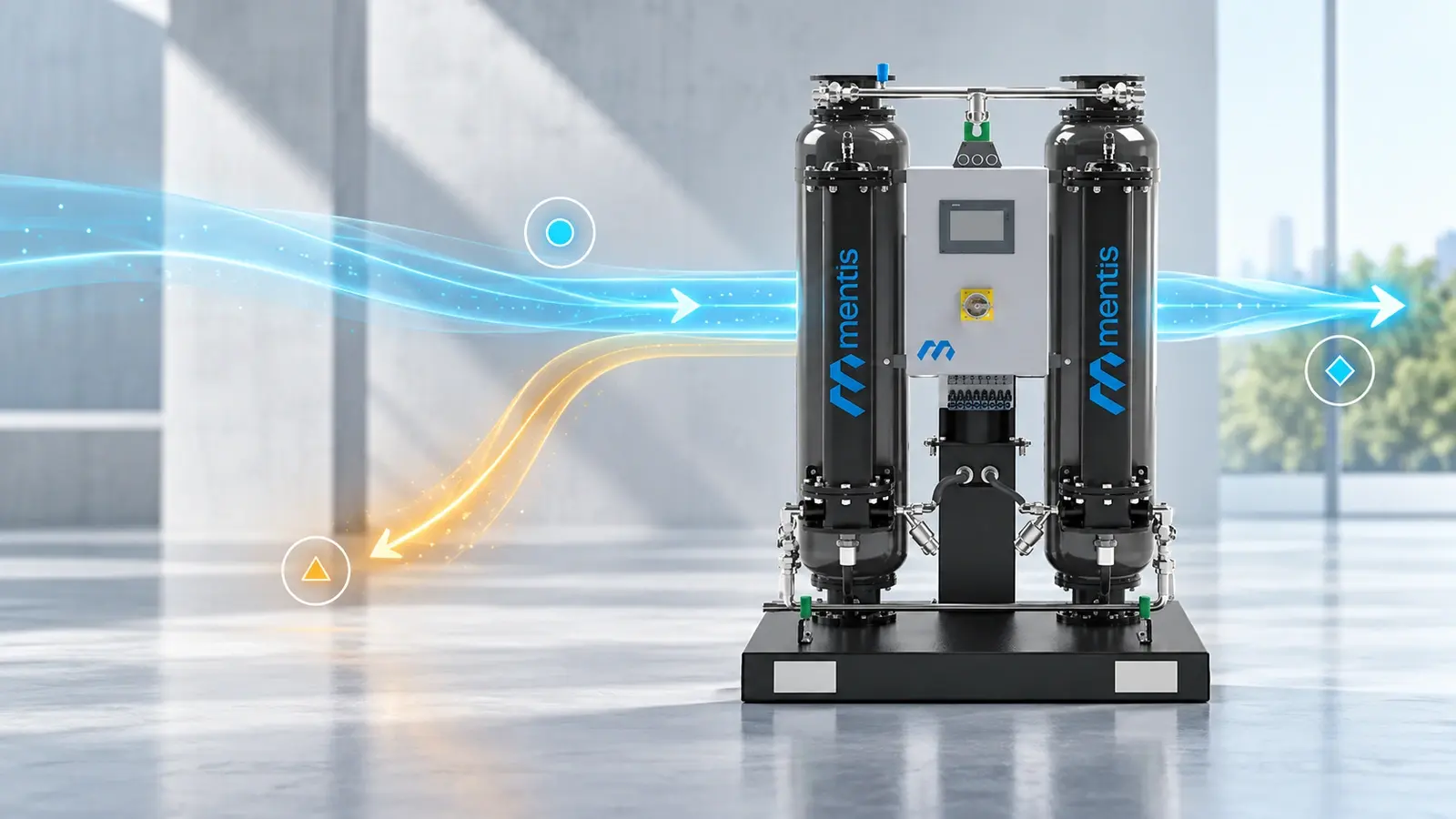
During initial start-up or a fault, PSA product gas may not meet its target quality. Displaying a purity value does not by itself prevent unsuitable gas from reaching the process. Quality limits, measurement validity, valve state and permission to supply the process must be considered within coordinated control logic.
Monitor residual oxygen limits in nitrogen systems and the required oxygen concentration in oxygen systems with an appropriately ranged analyser. Where moisture or other contaminants matter, verify them separately; oxygen measurement does not represent every aspect of gas quality. Sampling location, transport delay and analyser response time affect the design. Use an equipment- and process-specific stability criterion rather than one momentary acceptable reading.
Depending on the design, unacceptable gas is isolated from the process and routed to an approved vent system. A valve command is not proof of actual valve position; evaluate required position feedback and fault behaviour. Define what happens on analyser failure, sample loss, power loss or loss of control air. Vent routing requires engineering assessment of oxygen depletion or enrichment hazards; do not discharge arbitrarily into an enclosed workplace.
Verify start-up quality establishment, out-of-limit readings, invalid measurement, valve failure and recovery under controlled conditions. Agree the method and criteria before testing without contaminating the real process. If unsuitable gas remains in a product receiver or line, a recovered analyser reading alone does not prove quality at delivery. No universal alarm threshold or waiting time applies to every PSA plant.
Assess gas-quality requirements, analyser placement and process permissives with Mentis Engineering. Specify automatic diversion and backup supply needs explicitly in the project specification.