
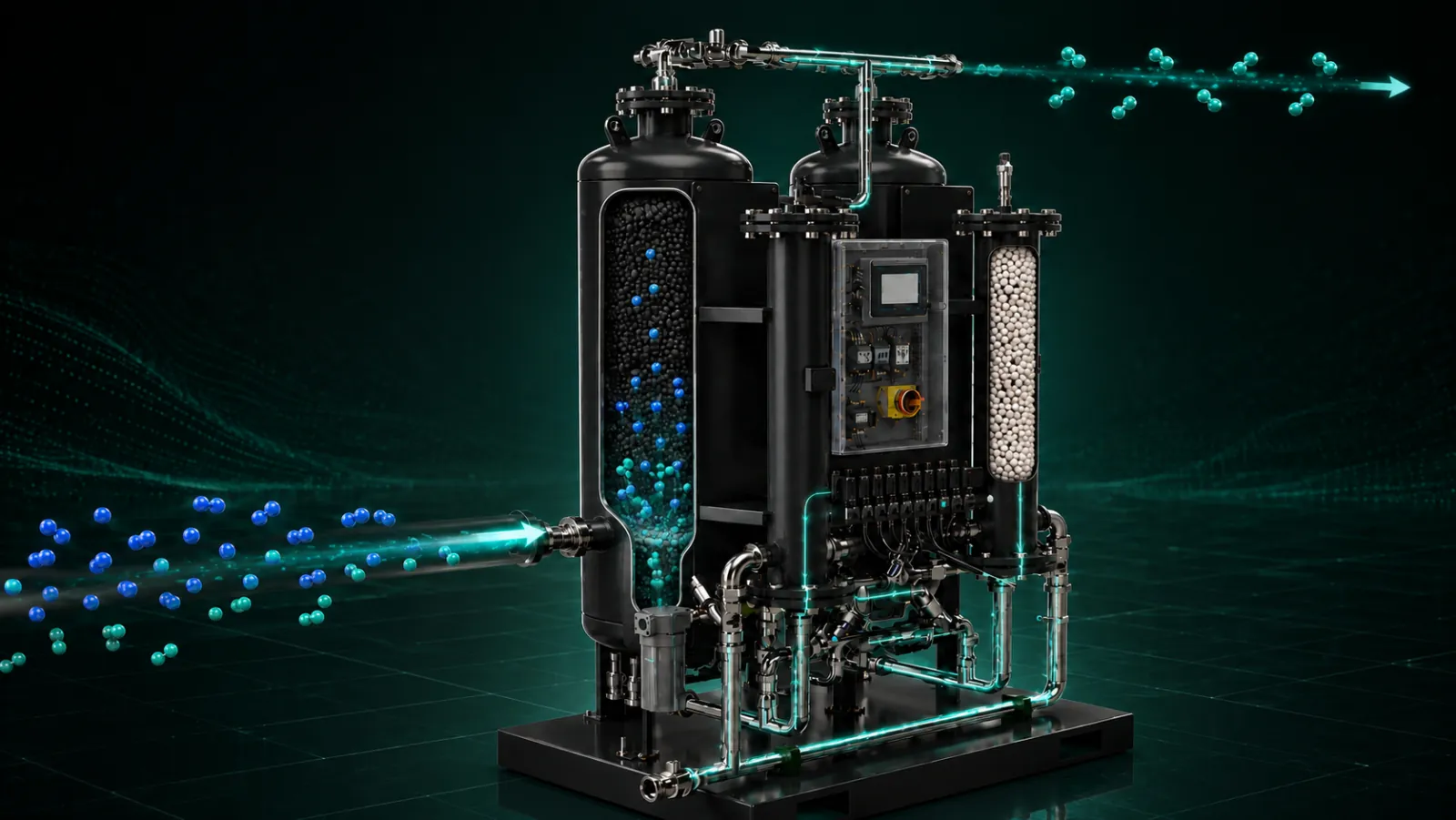
Short answer: A PSA nitrogen generator passes compressed air through Carbon Molecular Sieve (CMS). Oxygen is adsorbed more quickly while nitrogen-rich gas moves to the outlet. Alternating twin towers enable continuous 24/7 production.
Atmospheric air is about 78% nitrogen. A generator uses this feedstock to produce gas at the point of use without routine cylinder, bundle or liquid-nitrogen deliveries. A complete package includes a compressor, receiver, filters, drying, PSA unit, analyzer, nitrogen receiver and optional booster.
The value is broader than purchase-price savings. Delivery delays, cylinder handling, rental, stock, liquid evaporation and logistics are reduced, while electricity, maintenance and compressed-air quality become the main operating inputs.
• 1. Air treatment removes particles, oil aerosols and moisture.
• 2. Compressed air enters the first CMS bed; oxygen is adsorbed faster than nitrogen.
• 3. Nitrogen-rich product passes the analyzer and enters storage or the process.
• 4. PLC-controlled valves transfer feed to the second tower as the first approaches saturation.
• 5. The depressurized tower releases adsorbed gases and regenerates for the next cycle.
Because the towers alternate, production is continuous. If purity falls below the setpoint, automation can divert the gas instead of sending it to the process.
PSA is well suited to high, controlled purities and projects where flow and energy optimization matter. Membrane systems can be compact and effective for some medium-purity duties. The decision should consider purity, flow, pressure, dew point, temperature and annual hours.
• 95-99.5%: Selected inerting, purging, tank blanketing and fire-prevention duties.
• 99.9-99.99%: Food packaging, chemicals, heat treatment and general processing; the exact value is product-specific.
• 99.999-99.9995%: Electronics, precision soldering and selected pharmaceutical or high-specification processes.
• High-pressure laser cutting: Purity, booster flow, 20-40 bar or higher pressure and storage must be engineered together.
Unnecessarily high purity can reduce product flow and increase energy per Nm³. The lowest-cost system is the one that consistently meets the real process requirement.
• Flow and peak demand
• Purity and residual oxygen
• Delivery pressure and booster requirement
• Compressor, filters, dryer and ISO 8573-1 air quality
• Redundancy, analyzer, remote monitoring and PLC/HMI
• Altitude, temperature, electrical standard, containerization, installation and commissioning scope
A nitrogen-generator price is therefore not one catalogue number. Compare compressor power, dryer purge loss, receivers, booster, installation, maintenance and annual operating hours on the same boundary.
Annual net savings equal the annual external-supply cost minus PSA electricity, maintenance and consumables. Simple payback equals total investment divided by annual net savings. A robust model also includes energy and gas escalation, financing, downtime risk, liquid losses and residual value.
Patented S-PSA adds an integrated activated-alumina and activated-carbon protection stage before the CMS vessels. It supports adsorbent protection and purity stability and, under suitable conditions, can lower compressed-air consumption by up to 15% versus separate externally purged desiccant-dryer arrangements.
• Average and maximum Nm³/h
• Target purity and residual oxygen
• Pressure and permitted fluctuation
• Daily and annual hours
• Peak duration and storage
• Temperature, humidity and altitude
• Existing compressor and air quality
• Redundancy and allowable downtime
• Future expansion
• Installation, commissioning, remote service and maintenance scope
How much electricity does a nitrogen generator use?
It depends on purity, flow, compressor efficiency, inlet pressure and drying. Compare systems using kWh per Nm³ of delivered nitrogen.
Can it operate 24/7?
Yes, with correctly sized compression, cooling, storage, maintenance and optional N+1 redundancy.
How long does CMS last?
Life depends on air quality, moisture, oil, temperature, cycling and maintenance. Inlet-air treatment is critical.
How is purity measured?
An oxygen analyzer measures residual oxygen, from which nitrogen purity is calculated. Critical duties may need calibrated secondary verification.
Can PSA serve laser cutting?
Yes. Purity, pressure, booster flow, receiver size and machine peak demand must be matched.
PSA or liquid nitrogen: which costs less?
PSA often provides predictable cost for continuous demand, but lifecycle and ROI analysis using site data should decide.
What data is needed for a quotation?
Flow, purity, pressure, hours, peak profile, site conditions, electricity and existing compressed-air details.
Mentis Engineering can measure demand and engineer the PSA generator, compressor, drying, storage and booster package. Request a technical selection and ROI study.