
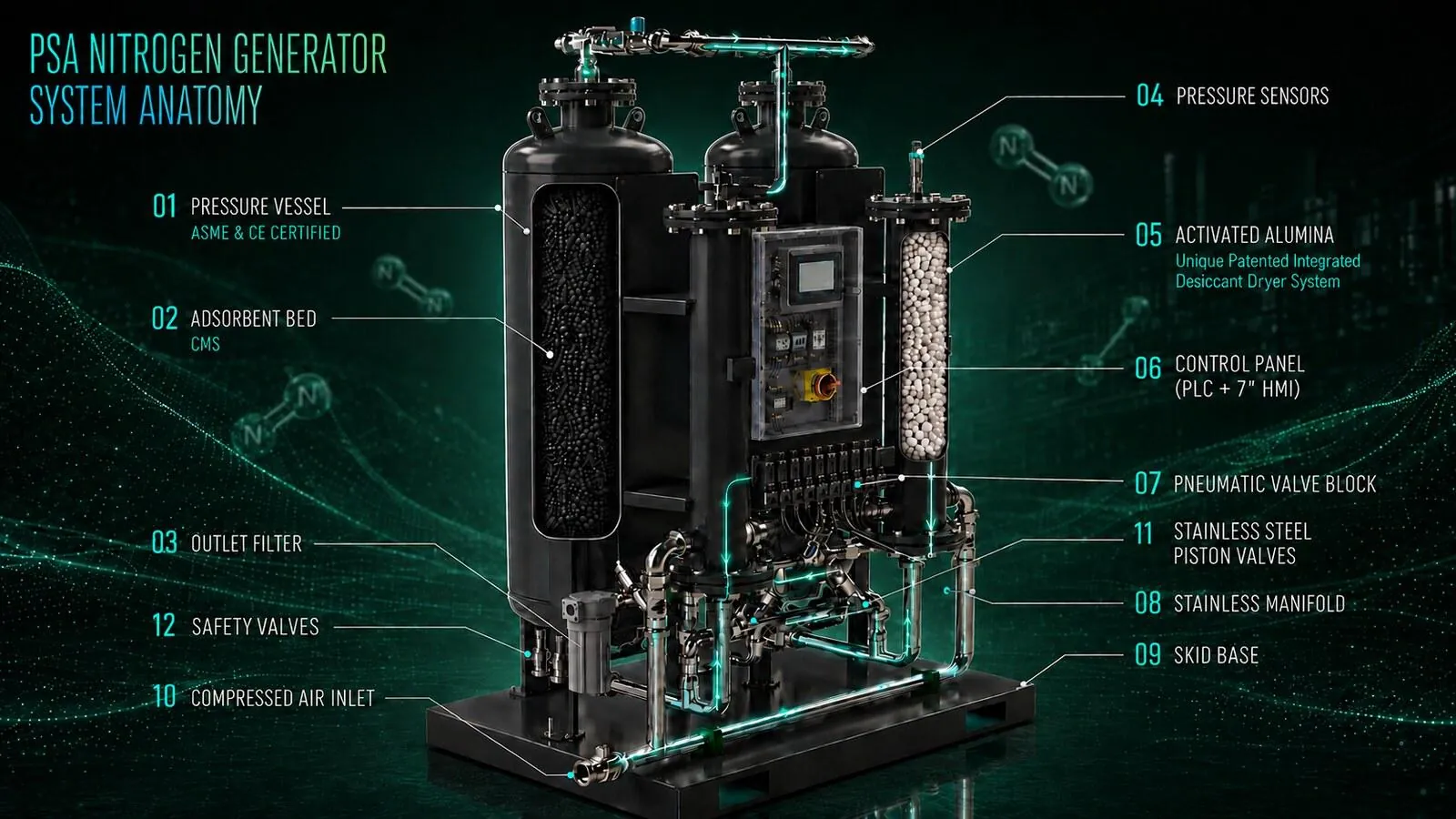
Air contains approximately 78% nitrogen. A PSA generator uses this readily available feedstock to reduce dependence on cylinders, bundles or bulk liquid nitrogen deliveries. A complete system typically includes compressed-air treatment, two adsorption vessels, CMS beds, pneumatic valves, stainless-steel manifolds, gas analysis and PLC/HMI automation.
Nitrogen purity, flow and pressure are engineered for the application. Depending on project requirements, Mentis PSA nitrogen generators can be configured for nitrogen purities from 95% up to 99.9995%.
The PSA cycle alternates two towers between adsorption and regeneration:
• Compressed-air inlet: Compressor air is filtered, dried and supplied to the PSA unit at a controlled pressure.
• Adsorption: Air enters the first CMS vessel. CMS adsorbs oxygen faster than nitrogen, so nitrogen-rich gas moves toward the outlet.
• Pressure equalization and switching: As the first bed approaches saturation, PLC-controlled valves transfer the feed to the second tower.
• Regeneration: Pressure in the saturated tower is reduced. Adsorbed oxygen and other components are exhausted, restoring the CMS for the next cycle.
• Continuous production: While one vessel produces nitrogen, the other regenerates. Product gas is analyzed and, when it meets the purity setpoint, sent to the process or nitrogen receiver.
• ASME- and CE-certified pressure vessels: Safely contain the CMS and withstand cyclic operating pressure.
• CMS adsorbent bed: Performs selective oxygen adsorption and nitrogen separation.
• Outlet filter: Captures possible particles in the product-gas line.
• Pressure sensors: Transmit vessel and process pressure data to the automation system.
• Activated alumina: Supports moisture removal in the integrated desiccant-dryer stage.
• Control panel with PLC and 7-inch HMI: Manages cycle timing, valve sequences, pressures, alarms and operating status.
• Pneumatic valve block: Distributes pilot air and actuates the process valves in the correct sequence.
• Stainless-steel piston valves and manifolds: Provide rapid cycling, low leakage and stable flow control.
• Safety valves: Protect pressurized equipment against potential overpressure.
• Skid base and compressed-air inlet: Integrate the equipment into a compact, installation-ready package.
CMS must be protected from water vapor, oil aerosols and contaminants. Mentis patented S-PSA approach places an integrated chemical drying and filtration stage containing activated alumina and activated carbon upstream of the main PSA towers. This supports adsorbent life and stable purity. Depending on design and operating conditions, it can reduce compressed-air consumption by up to 15% compared with configurations that require separate purge air for an external desiccant dryer.
• Laser cutting and metal processing: High-pressure assist gas, lower oxidation and clean cut edges.
• Food and beverage: Modified-atmosphere packaging, tank blanketing and oxidation control.
• Chemical and petrochemical plants: Tank blanketing, inerting, purging and reactor protection.
• Electronics manufacturing: Controlled inert atmospheres for reflow and wave soldering.
• Pharmaceuticals and biotechnology: Protection of oxygen- or moisture-sensitive processes and packaging.
• Heat treatment and metallurgy: Controlled atmospheres and reduced surface oxidation.
• Marine, oil and gas: Pipeline purging, tank inerting and fire-risk reduction.
• Rubber, cable and plastics: Inert gas for production, curing and extrusion processes.
On-site generation reduces cylinder handling, tanker scheduling, rental fees, transport exposure and delivery delays. The user produces the purity the process actually needs and avoids the energy penalty of unnecessary over-purification. A correctly sized system provides continuous availability, predictable unit cost, automated operation and fewer logistics movements.
Required flow in Nm³/h, purity, delivery pressure, daily operating hours, peak demand, ambient temperature, altitude, compressed-air quality and redundancy must be evaluated together. High-pressure applications such as laser cutting may also require a nitrogen booster and high-pressure storage system.
What purity can a PSA nitrogen generator produce?
Purity depends on CMS selection and cycle settings. Mentis systems can be configured between 95% and 99.9995%, according to the process requirement.
Can a PSA nitrogen generator operate continuously?
Yes. Two adsorption towers alternate so one produces while the other regenerates. With suitable compressor, receiver and redundancy design, 24/7 operation is possible.
Does higher nitrogen purity use more energy?
Generally, yes. Higher purity can require more compressed air or reduce product flow. The system should therefore be designed for the purity genuinely required by the process.
Is PSA nitrogen-generator maintenance difficult?
Routine work typically covers filter elements, valves, analyzer calibration, air-quality checks and leak inspection. Correct inlet-air treatment is critical to CMS life.
Is PSA or liquid nitrogen more economical?
The answer depends on consumption, purity, electricity price, logistics and operating hours. For continuous or high demand, on-site PSA production often offers a more predictable and economical supply. A lifecycle-cost and ROI study should confirm the decision.
Mentis Engineering sizes the PSA nitrogen generator, compressor, drying, storage and booster package around your flow, purity, pressure and site conditions. Request an application-specific technical selection and ROI study.