
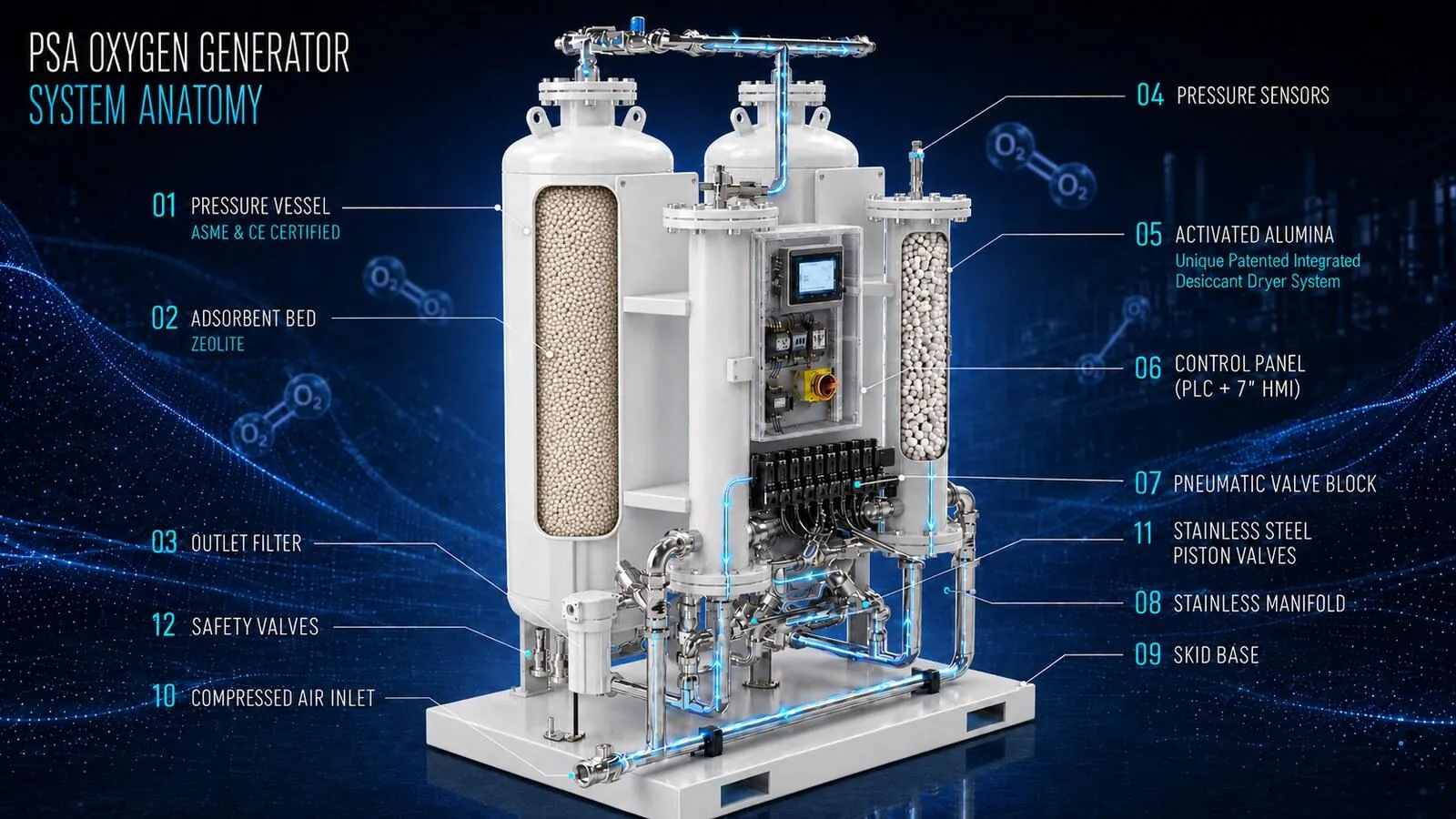
Short answer: A PSA oxygen generator is an automated system that compresses atmospheric air and passes it through zeolite molecular-sieve beds. The zeolite selectively adsorbs nitrogen, allowing oxygen-enriched product gas to be generated on site. PSA stands for Pressure Swing Adsorption.
Atmospheric air contains approximately 21% oxygen and 78% nitrogen. A PSA system raises the oxygen concentration by retaining nitrogen on zeolite. This reduces dependence on cylinders, bundles or bulk liquid oxygen deliveries and enables the user to generate oxygen at the point of demand.
A complete plant can include an air compressor, air receiver, filtration and drying, two zeolite adsorption vessels, pneumatic valves, stainless-steel manifolds, an oxygen receiver, gas analysis and PLC/HMI automation. Mentis PSA oxygen generators are configured for project-specific flow, pressure and purity. Standard PSA applications commonly operate in the 90–95% range; depending on configuration, the Mentis range includes solutions up to 99.5%. For medical use, target purity and system compliance must be verified against applicable local regulations and project requirements.
• Air preparation: Atmospheric air is compressed; particles, oil aerosols and moisture are reduced through filtration and drying.
• Adsorption: Conditioned air enters the first zeolite vessel. Zeolite preferentially adsorbs nitrogen while oxygen-enriched gas moves toward the outlet.
• Tower switching: As the first bed approaches saturation, PLC-controlled valves direct compressed air to the second vessel.
• Regeneration: Pressure in the saturated vessel is reduced and retained nitrogen is released to atmosphere.
• Analysis and storage: Oxygen concentration is monitored continuously. Gas that meets the purity setpoint is sent to the oxygen receiver or directly to the process.
Because the vessels alternate, one produces while the other regenerates, delivering a continuous oxygen flow.
• ASME- and CE-certified pressure vessels: Safely contain the zeolite and withstand cyclic operating pressure.
• Zeolite adsorbent bed: Selectively adsorbs nitrogen to produce oxygen-enriched gas.
• Outlet filter: Captures possible particles in the product line.
• Pressure sensors: Send vessel and process-pressure data to the control system.
• Activated alumina: Supports moisture removal in the integrated desiccant dryer.
• Control panel with PLC and 7-inch HMI: Manages cycles, valves, pressures, alarms and operating status.
• Pneumatic valve block: Distributes pilot air to the process-valve actuators.
• Stainless-steel piston valves and manifolds: Provide rapid switching, low leakage and stable flow.
• Safety valves: Protect pressurized equipment against potential overpressure.
• Skid base and compressed-air inlet: Integrate the package for compact installation.
Zeolite can be affected by moisture, oil vapor and particulates. Mentis patented S-PSA approach places an integrated chemical drying and filtration stage containing activated alumina and activated carbon upstream of the main PSA vessels. This stabilizes inlet air, protects the zeolite and supports consistent oxygen purity. Depending on design and operating conditions, compressed-air consumption can be reduced by up to 15% compared with configurations requiring separate purge air for an external desiccant dryer.
• Hospitals and healthcare facilities: Central oxygen supply when the design, certification and applicable regulations are satisfied.
• Aquaculture and fish farms: Higher dissolved oxygen to support stocking density, fish health and productivity.
• Wastewater treatment: Support for biological processes, oxidation and treatment capacity.
• Ozone generation: Oxygen feed to increase ozone concentration and process efficiency.
• Gold mining and leaching: Support for oxidative reactions and process kinetics.
• Glass, ceramics and metals: Oxygen-enriched combustion for higher flame temperature and efficiency.
• Pulp and paper, chemical and pharmaceutical: Controlled oxidation and oxygen-dependent processes.
• Brazing, welding and cutting: Process-specific oxygen supply at the required purity and pressure.
On-site production reduces cylinder handling, liquid-oxygen deliveries, rental, filling and logistics exposure. Oxygen is produced automatically at the point of demand, making unit cost more predictable. Correctly sized storage, redundancy and backup systems strengthen continuity of supply while reducing tanker traffic and cryogenic-product handling.
Hourly and daily oxygen consumption, peak flow, purity, delivery pressure, operating hours, altitude, ambient temperature, air quality, redundancy and storage must be assessed together. Hospitals and other critical applications also require suitable backup, alarms, gas analysis, medical filtration and distribution infrastructure within the project scope.
What purity does a PSA oxygen generator produce?
Standard PSA systems commonly produce 90–95% oxygen. Depending on project and configuration, the Mentis range includes solutions up to 99.5%. Final performance depends on flow, pressure, zeolite, cycle settings and process requirements.
Can a PSA oxygen generator operate 24/7?
Yes. Two vessels alternate between production and regeneration. Continuous operation requires correctly sized compression, storage, cooling, redundancy and maintenance planning.
Can PSA oxygen be used in hospitals?
Yes, when the medical design, gas quality, analysis, alarms, filtration, backup supply, certification and local regulatory requirements are satisfied.
How long does zeolite last?
Service life depends on inlet-air quality, moisture, oil carryover, temperature, cycle settings and maintenance. Effective air treatment and disciplined maintenance significantly support zeolite life.
Is PSA or liquid oxygen more economical?
The result depends on consumption, electricity, operating hours, delivery distance, liquid-oxygen losses and backup requirements. For continuous demand, PSA often provides more predictable cost and greater supply independence. A lifecycle-cost and ROI analysis should confirm the decision.
Mentis Engineering evaluates the complete oxygen system, including compression, air treatment, PSA generation, storage, analysis, boosting and backup. Request a project-specific technical selection and ROI study.