
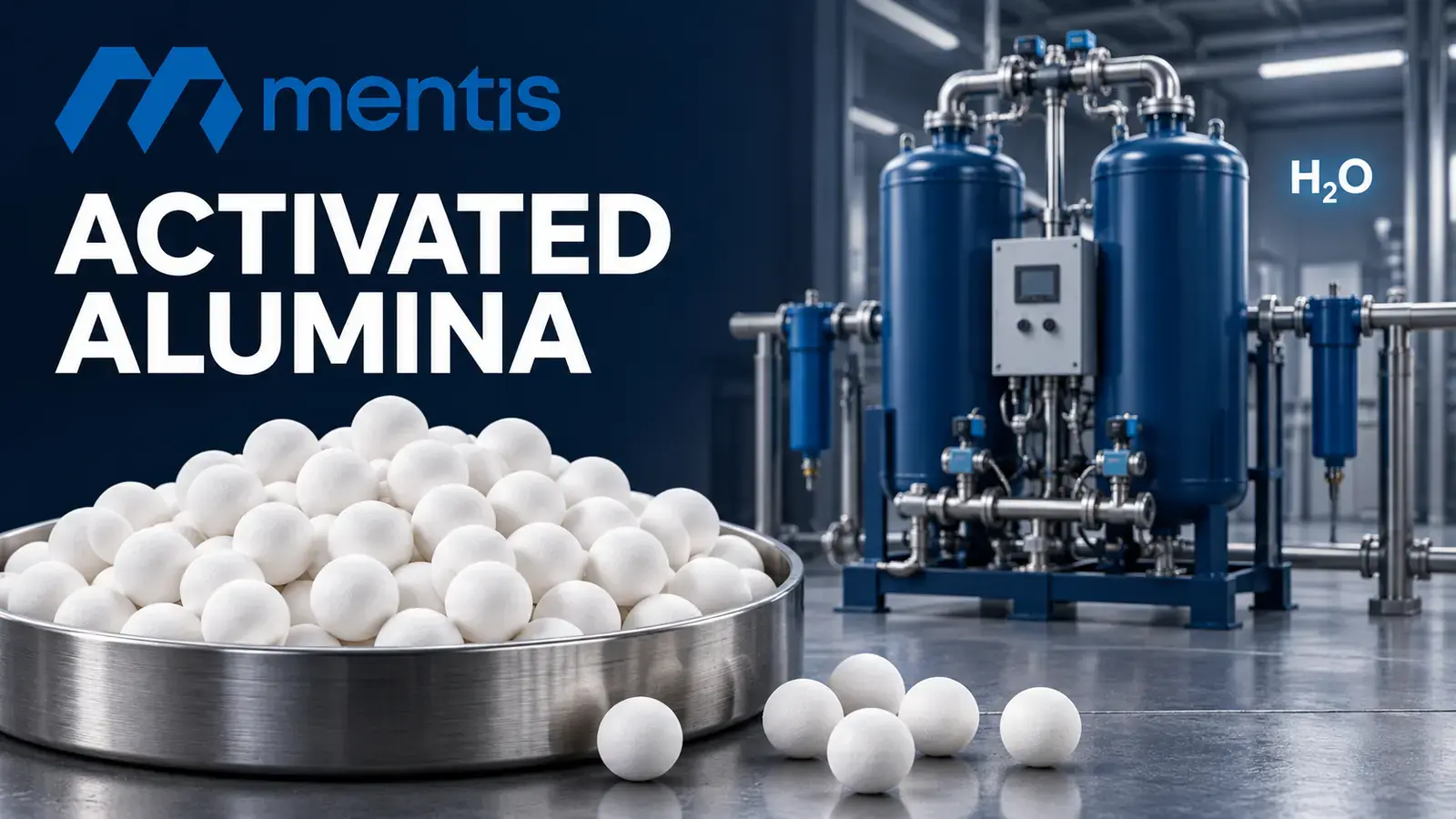
The white beads inside a desiccant dryer do more than fill a vessel: they manage the process moisture load. Activated alumina is a porous aluminium oxide adsorbent with a large internal surface. It dries air and gases by retaining water vapour; the resulting performance depends on both the material and the system.
Common industrial routes partially dehydrate aluminium hydroxide under controlled conditions to develop an active porous structure. Shaping, ageing and heat-treatment stages depend on the production method. The finished material may be supplied as spheres or other granules. Pore volume, mechanical strength and dust generation are important indicators of product quality. [2]
Water molecules adsorb onto the polar surface of activated alumina. As the drying bed becomes loaded, regeneration removes retained water using suitable dry purge gas, heat or a combination, depending on dryer design. Achievable outlet moisture depends on inlet conditions, the operating cycle and the effectiveness of regeneration. [1] [3]
Key uses include compressed-air dryers, instrument air, gas and liquid drying, and pretreatment for air separation. Suitable grades also serve chemical purification, selected water-treatment duties and catalyst-support applications. Selection for water treatment depends on water chemistry and the target contaminant; a standard air-drying grade is not automatically suitable for every purification duty. [3] [4]
No single material is best for every drying duty. Very low residual-moisture targets may require a suitable molecular sieve or an engineered layered bed. Some systems combine activated alumina and molecular sieve. Avoid changing an existing bed's material order or loading quantity solely because an alternative costs less. [5]
Start with flow, pressure, inlet temperature, moisture load and the required pressure dew point. Then evaluate particle size, crush strength, cyclic durability, pressure drop and regeneration energy. The same adsorbent does not guarantee the same dew point in different dryers. Check batch documentation and the equipment manufacturer's loading requirements.
Deteriorating outlet dew point, excessive dust or bed damage require investigation. First inspect drains, oil filtration, regeneration flow, valves and the heater where fitted. Replacing the desiccant without correcting the root cause may not produce lasting improvement. Keep fresh material in sealed packaging until loading to limit moisture pickup.
Contact Mentis about a new desiccant dryer or an assessment of your existing bed. Share the dryer model, air flow, operating pressure, inlet temperature and target dew point. We can evaluate adsorbent selection alongside pretreatment, regeneration and maintenance to prepare a quotation aligned with your operating needs. [Mentis]