
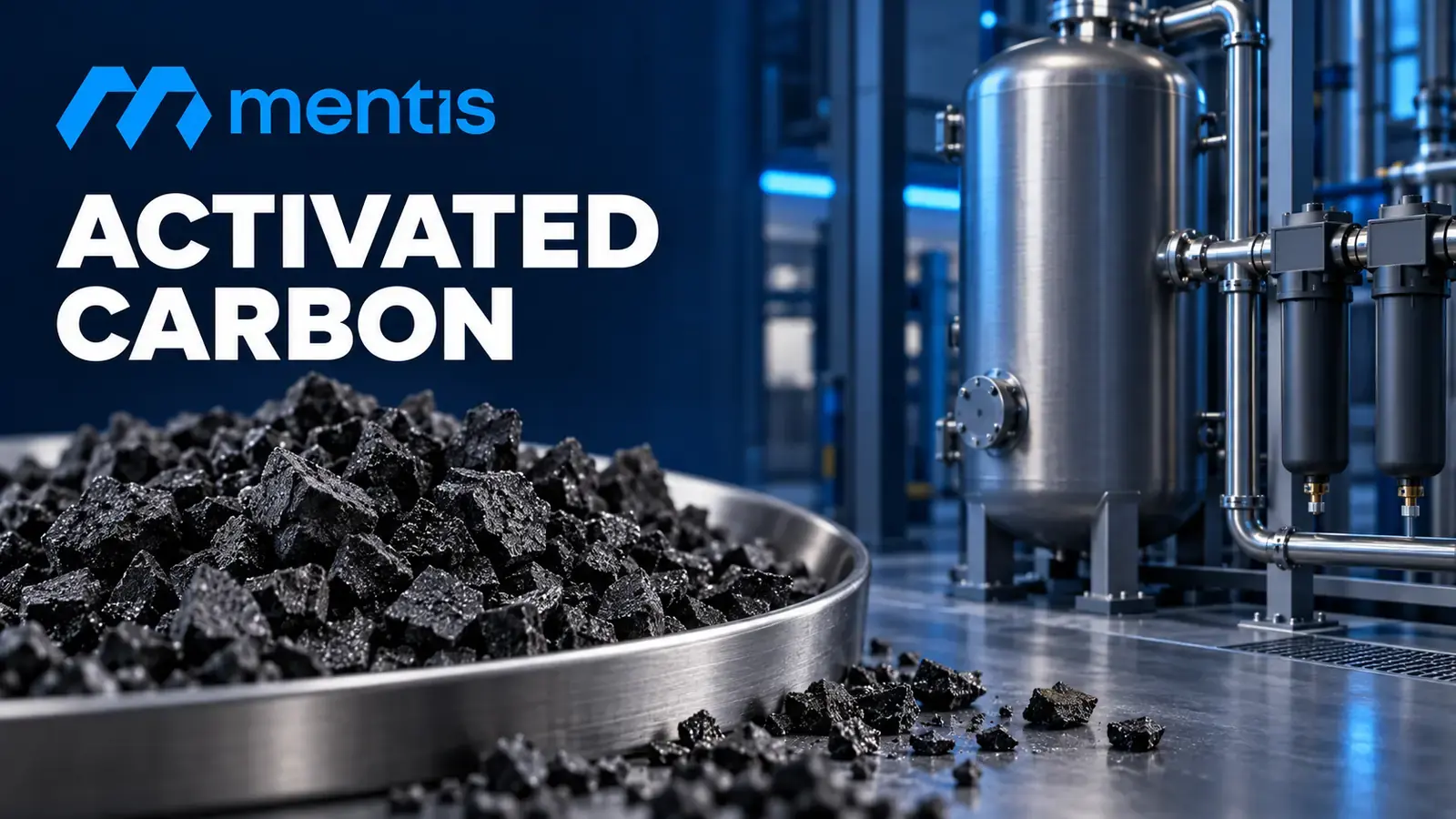
Invisible oil vapour in compressed air can affect process quality. Activated carbon is a porous carbon material processed to develop a large internal surface. It captures suitable contaminants on that surface through adsorption, making it useful in air, gas and liquid purification.
Carbon-rich feedstocks include coconut shells, coal and wood. Carbonisation and activation develop the pore network. Physical activation uses agents such as steam or carbon dioxide; chemical activation uses suitable activating chemicals. Washing, drying and sizing depend on the manufacturing route. The feedstock and processing conditions shape the final pore-size distribution. [1] [2]
Suitable molecules from a liquid or gas attach to the carbon's internal surface. Physical adsorption is the main mechanism, while specialised impregnated grades may also rely on chemical reactions. Capacity depends on contaminant identity, concentration, temperature, humidity and contact time. A single carbon grade will not remove every contaminant equally well. [1] [5]
Coalescing filters remove liquid droplets and oil aerosols, while oil in the vapour phase may require an adsorption stage. A correctly sized activated carbon tower addresses that duty. Upstream filtration and drying protect the bed; a downstream particulate filter limits carbon dust carryover. Activated carbon does not replace an air dryer. [3]
Applications include compressed-air and process-gas treatment, odour and volatile organic compound control, water treatment, solvent recovery and food processing. Suitable specialised grades are used for gold recovery or particular gas contaminants. Carbon products for these duties can differ substantially in particle structure, pore distribution and chemical treatment. [1] [5]
Start with the contact system and target contaminant. Granules and pellets can suit fixed beds; powdered carbon can suit appropriate dosing and separation processes. Assess pressure drop, mechanical strength, dusting and relevant adsorption data together. Iodine number or surface area alone cannot explain the performance of the carbon in your actual process.
Adsorption capacity is finite. Rising outlet contamination, operating load and appropriate analysis guide replacement planning; differential pressure alone does not indicate saturation. Some spent carbons can be reactivated at specialist facilities. That process is different from assuming a compressed-air carbon tower automatically regenerates during normal operation. [4]
Speak with Mentis about improving compressed-air quality or protecting PSA feed air. Share flow, pressure, inlet temperature, existing filter and dryer arrangements, and target air quality. We can assess an activated carbon tower alongside pretreatment and maintenance requirements, then prepare a quotation for your application. [Mentis]