
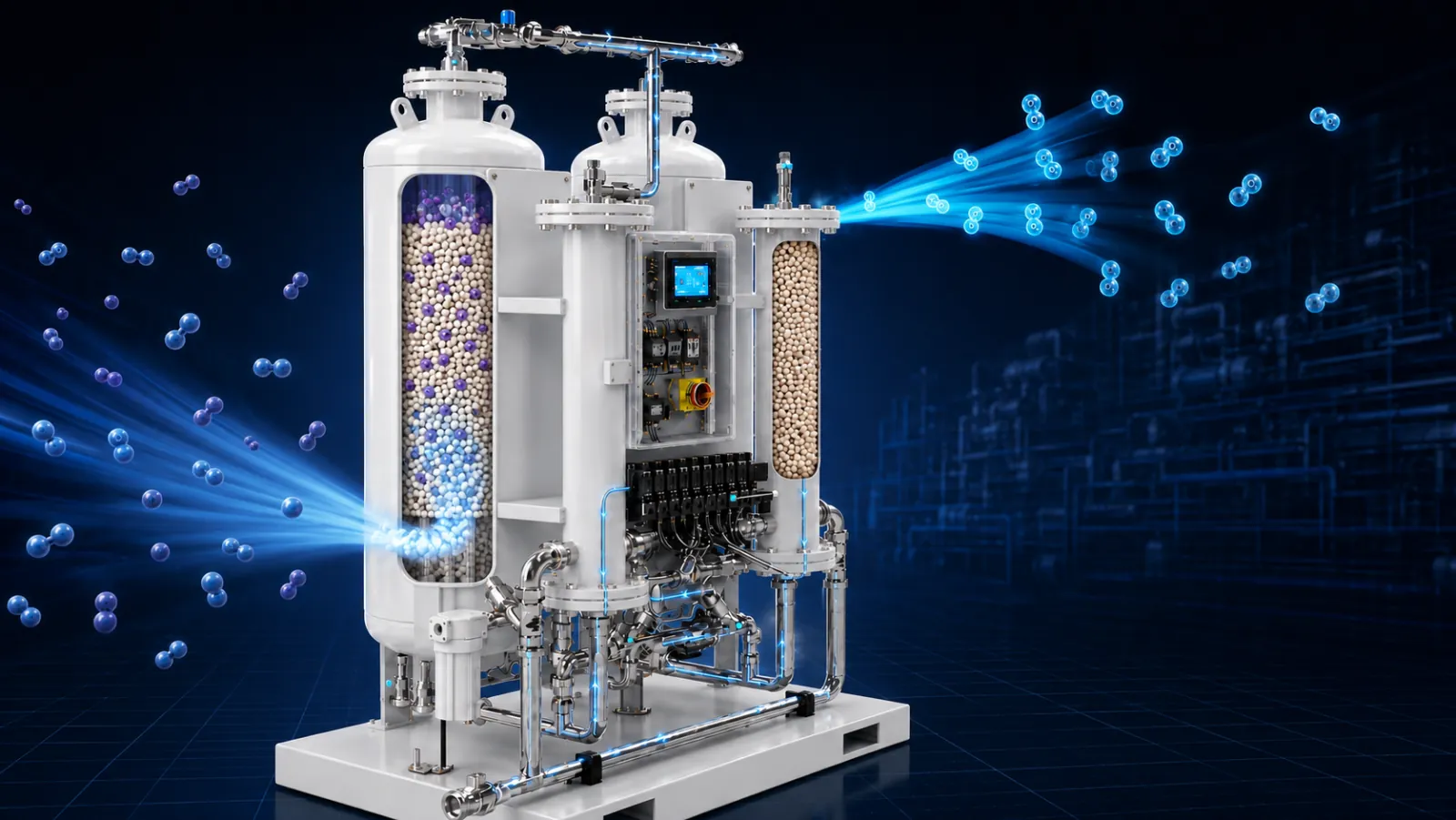
Short answer: A PSA oxygen generator passes treated compressed air through zeolite beds. Zeolite preferentially adsorbs nitrogen, while oxygen-rich gas is analyzed and sent to storage or the process. Alternating twin towers make production continuous.
Atmospheric air contains about 21% oxygen and 78% nitrogen. PSA concentrates oxygen by retaining nitrogen. A complete plant includes a compressor, air receiver, filters and drying, PSA, oxygen analyzer, product receiver, controls and an optional oil-free oxygen booster.
On-site production can reduce cylinder handling, liquid deliveries, rental, inventory and evaporation losses. Electricity, maintenance, inlet-air quality, backup supply and storage must still be evaluated together.
• 1. Air treatment controls particles, oil aerosols and moisture.
• 2. Zeolite in the first tower preferentially adsorbs nitrogen.
• 3. Oxygen-rich product passes the analyzer to storage or process.
• 4. PLC switches feed to the second tower near saturation.
• 5. The depressurized tower releases nitrogen and regenerates.
The analyzer continuously checks concentration. Gas below setpoint can be diverted before it reaches a critical user.
The common PSA range is 90-95%; depending on project and configuration, Mentis can offer solutions up to 99.5%. Higher purity can reduce flow or increase energy, so the real process requirement should drive selection.
• Medical: A common target is 95% ±1; pharmacopoeia, regulation, certification, analysis, alarms, filtration and backup must be confirmed.
• Aquaculture and wastewater: Dissolved-oxygen target, transfer efficiency, pressure and peak demand matter alongside purity.
• Ozone, mining and process duties: Follow the inlet-gas requirements of the ozone generator or process provider.
• Cylinder filling and high pressure: Add an oil-free booster, storage, manifold and oxygen-service safety design.
PSA is compact and flexible for many small to medium-high flow duties requiring typical product pressure of 4-6.5 bar. VPSA uses vacuum regeneration and can offer specific-energy and scale benefits at very high flow. At roughly 3,000 Nm³/h and above, VPSA should be included in the technical-economic comparison; pressure, purity, electricity, altitude, redundancy and site conditions determine the final threshold.
• Hourly, daily and peak oxygen demand
• Purity and delivery pressure
• Compressor power, air quality, filters and drying
• Oxygen receiver, booster, high-pressure storage or filling capacity
• Analyzer, PLC/HMI, alarms, remote monitoring and medical filtration
• N+1 redundancy, emergency supply and maintenance scenario
• Altitude, temperature, electricity, container, piping, installation and commissioning
Compare complete systems on the same supply boundary, including compressor kW, dryer purge, receivers, backup, installation and annual maintenance—not the PSA skid price alone.
External annual cost includes gas, rental, freight, deliveries and liquid losses. PSA annual cost includes electricity, maintenance, filters, analyzer calibration and planned consumables. Annual net savings are the difference; simple payback is investment divided by net savings.
Patented S-PSA uses activated alumina and activated carbon upstream of the zeolite vessels to support protection from moisture, oil vapor and contaminants. Under suitable conditions it can lower compressed-air consumption by up to 15% versus separate externally purged desiccant-dryer arrangements.
• Average and peak hourly/daily demand
• Purity and tolerance
• Pressure
• Operating hours and allowable downtime
• Storage/autonomy time
• Altitude, temperature and humidity
• Existing compressor and air quality
• Backup and N+1
• Future expansion
• Regulatory, installation, commissioning and maintenance scope
What purity does PSA produce?
The common range is 90-95%; Mentis can offer configurations up to 99.5% depending on the project.
Can it be used in a hospital?
Yes, when medical design, gas quality, pharmacopoeia, certification, alarms, analysis, filtration, backup and local regulations are satisfied.
Can it operate 24/7?
Yes, with correctly sized compression, cooling, storage, maintenance and redundancy.
How long does zeolite last?
Life depends on moisture, oil, temperature, cycling, hours and maintenance. Effective air treatment is essential.
PSA or liquid oxygen?
PSA often offers predictable cost for continuous demand, but site-specific electricity, gas price, losses and backup determine ROI.
How is aquaculture capacity selected?
Use biomass, water temperature, dissolved-oxygen target, transfer efficiency, night/peak profile and redundancy.
What about flows above 3,000 Nm³/h?
Compare VPSA with PSA for specific energy and scale economics; pressure and site conditions decide.
Mentis Engineering evaluates compression, air treatment, PSA/VPSA, storage, booster, backup and ROI in one project. Contact us for technical selection.