
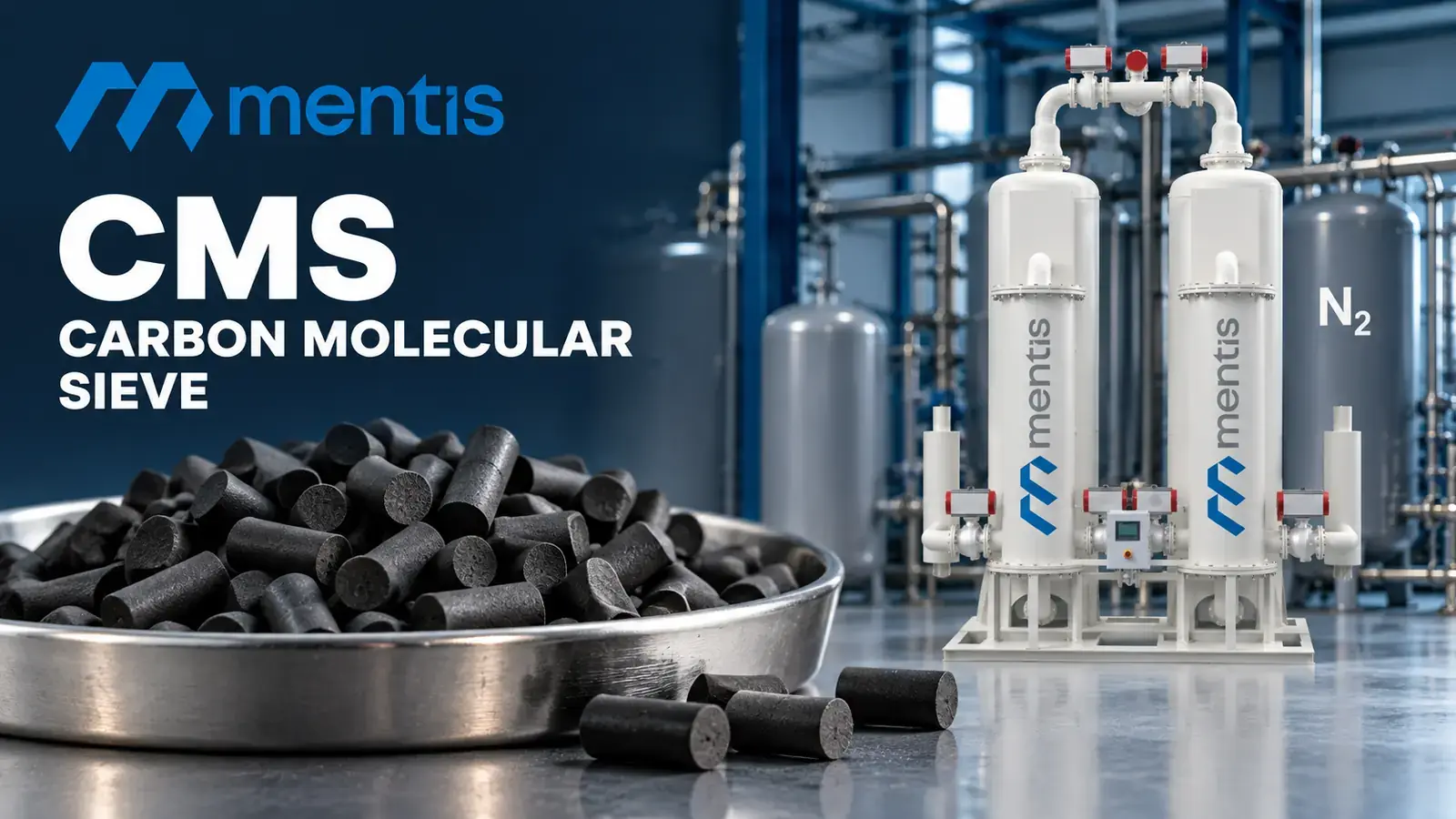
The same compressor can deliver very different nitrogen results depending on the separation system. Carbon Molecular Sieve, or CMS, is a carbon-based adsorbent with carefully engineered pore entrances. In PSA nitrogen generators, it exploits differences in the rates at which oxygen and nitrogen enter the pores.
Production starts with preparing a selected carbon-rich feedstock, shaping it and carbonising it. Activation and pore-narrowing treatments depend on the manufacturing route. One established approach deposits carbon at pore entrances through controlled thermal decomposition of hydrocarbons. The objective is selective pore access, not simply the largest possible surface area. [2]
When compressed air enters the bed, oxygen diffuses into CMS pores faster than nitrogen and is preferentially retained during the adsorption step. A nitrogen-rich stream is collected. Depressurisation releases adsorbed gases and prepares the bed for reuse. Alternating-bed timing influences nitrogen recovery, product purity and air consumption. [3] [4]
Both are carbon-based, but they serve different purposes. General-purpose activated carbon is commonly selected to capture organic contaminants. CMS is engineered for gas separation through different diffusion rates. Filling a nitrogen generator with ordinary activated carbon instead of its specified CMS does not provide equivalent separation performance. [1] [5]
Its principal application is on-site PSA nitrogen production. With suitable purity and conditioning, the nitrogen can support laser cutting, food packaging, tank blanketing, electronics manufacturing and heat treatment. Other CMS grades can serve certain biogas-upgrading processes. A different gas mixture may require a different adsorbent and operating cycle. [1]
Define the purity target, required flow, pressure, inlet-air temperature and operating hours. Compare capacity and air-consumption figures under equivalent test conditions. Particle size, packing density, dust generation and cycle compatibility also matter. Higher purity requirements often change available product flow and air demand, so a purity figure alone cannot define the system.
Feed-air preparation must protect the bed from oil, water and particles. If purity deteriorates, inspect leaks, filters, drains, valves and the oxygen analyser before assuming the CMS needs replacement. Routine regeneration by pressure cycling does not mean oil-contaminated CMS has been cleaned. Base replacement decisions on measured performance and operating condition.
Contact Mentis for a new PSA nitrogen system or a performance assessment of your existing generator. Share the purity target, average and peak consumption, delivery pressure and equipment model. We can assess CMS selection, drying, filtration and cycle control together to define a relevant quotation. [Mentis]