
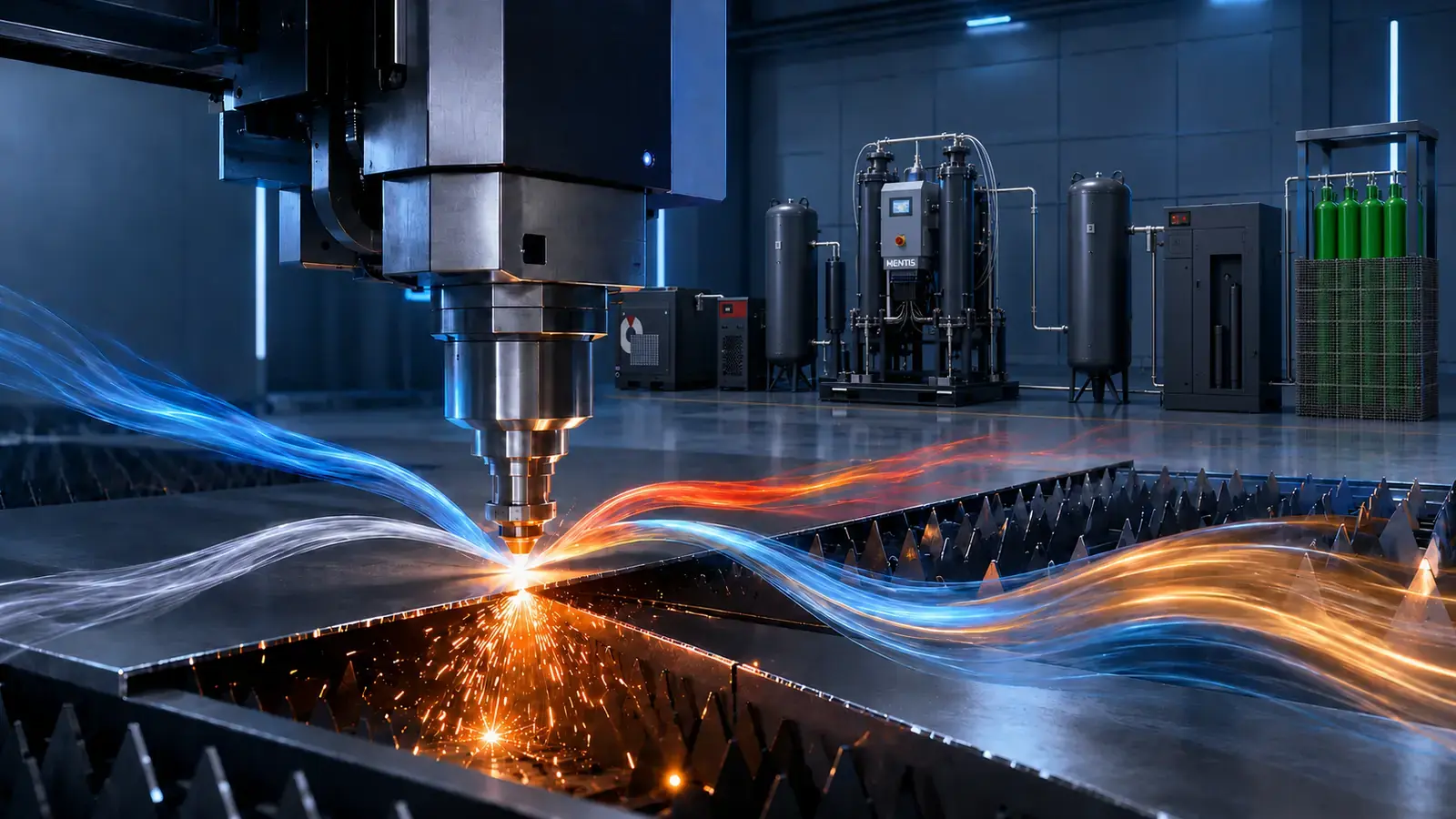
The right assist gas affects far more than cutting speed. It also determines edge color, dross, downstream processing and total cost per part. This guide compares nitrogen, oxygen, dry compressed air and MixGas for fiber laser systems from 3 kW to 30 kW.
|
The short answer: there is no single best gas. The right choice is the result of material, thickness mix, required edge quality, laser power and the plant's real peak gas demand. |
The fiber laser source delivers heat; the assist gas ejects molten metal from the kerf, controls the chemical behavior in the cut zone and shapes the final edge. Two machines with the same optical power can therefore deliver very different speeds and edge quality when gas type, purity or dynamic pressure changes.
Gas selection also affects hidden costs. Oxide, dross and discoloration can add grinding, paint preparation, welding risk and corrosion concerns. A sound comparison looks beyond the price per cubic meter and evaluates total cost per finished part.
Nitrogen is an inert assist gas. It does not add reaction heat; instead, a high-pressure jet removes the melt. It is the primary choice for bright, oxide-free edges on stainless steel and aluminum. It can also be used on mild steel when a clean edge or easier downstream painting and welding is valuable.
The trade-off is high instantaneous flow and pressure, especially on thicker sheet. Even small oxygen contamination can discolor stainless edges, so purity, piping cleanliness and pressure at the machine must be controlled together.
Oxygen is an active gas. Its exothermic reaction with carbon steel adds heat to the process, allowing thicker mild-steel sections to be cut with less laser power. Gas consumption is often lower than with nitrogen.
The edge, however, carries an oxide layer. If the part will be painted, welded or bonded, oxide removal may be required. Oxygen service also requires a separate, clean and oxygen-compatible line designed with the correct safety practices.
Dry air naturally contains nitrogen and oxygen, combining inert and active cutting behavior. It can lower gas cost on thin and medium gauges, particularly in general fabrication, provided slight oxidation or color change is acceptable.
Low-cost air is not untreated shop air. Moisture, oil vapor and particles can harm process stability, surface quality and optical components. A laser-quality air system needs drying, oil and particle control, suitable pressure boosting and adequate buffer volume.
MixGas introduces a controlled amount of oxygen into nitrogen. In the right material and thickness window, the goal is to use the reaction benefit of oxygen while preserving the melt-ejection and speed advantages associated with nitrogen cutting. It can create a useful balance of speed, dross and edge quality on medium-gauge mild steel.
MixGas is not a universal recipe. The ratio must be validated for laser power, steel grade, surface condition, thickness, nozzle, focus and the customer's acceptance criteria. Stable results depend on matched inlet pressures, repeatable ratio control, backflow protection and gas analysis.
The values below are typical engineering preselection windows for an initial discussion across 1-30 mm; they are not a machine guarantee or a substitute for an OEM cutting chart. Laser source, cutting head, beam shaping, nozzle, alloy/grade, surface condition, dynamic gas pressure and OEM parameters can shift the result. Overlapping windows show that the same thickness may be cut with different gases for different quality and cost targets.
|
Power |
Mild steel |
Stainless steel |
Aluminum |
|
3 kW |
1-4 mm N2/air | 4-8 mm MixGas | 6-20 mm O2 |
1-8 mm N2; validate 10-12 mm |
1-6 mm N2; validate 8 mm |
|
6 kW |
1-6 mm N2/air | 6-12 mm MixGas | 8-25 mm O2 |
1-16 mm N2; validate 18-20 mm |
1-12 mm N2/air; validate 14-16 mm |
|
12 kW |
1-12 mm N2/air | 6-20 mm MixGas | 12-30 mm O2 |
1-25 mm N2; validate 30 mm |
1-20 mm N2/air; validate 25 mm |
|
30 kW |
1-20 mm N2/air | 4-20 mm MixGas | 12-30 mm O2 |
1-30 mm N2 |
1-30 mm N2/air |
Technical note: The table shows typical preselection windows. Final cutting capacity, gas recipe and quality must be verified against the laser OEM data and confirmed through sample cutting.
For mild steel, the decision balances clean edges against thickness capability and gas economy. High-purity nitrogen is usually the starting point for stainless steel and aluminum. Coating behavior must be checked on galvanized sheet; reflective-metal protection and cutting-head compatibility must be verified for brass and copper. Reactive metals such as titanium sit outside this general matrix and need a dedicated process review.
|
Material |
Primary choice |
Alternative / key caution |
|
Mild steel |
N2, MixGas or O2 |
N2 for clean edges; MixGas for medium gauges; O2 for thickness and lower gas flow |
|
Stainless steel |
High-purity N2 |
Dry air only when color/oxide is acceptable; O2 is not recommended |
|
Aluminum |
N2 |
Dry air for general fabrication; validate alloy and surface requirement |
|
Galvanized steel |
N2 or dry air |
Verify coating behavior and fume management |
|
Brass / copper |
N2 |
Verify back-reflection protection, cutting head and alloy compatibility |
A 3 kW machine may appear manageable on average consumption, while the speed of a 12 or 30 kW system can create much higher instantaneous nitrogen demand. Sizing only for average flow can cause pressure drop and inconsistent quality during cutting. The design should be based on the hardest recipe, the number of simultaneous machines, shift pattern and peak demand.
A typical on-site nitrogen architecture combines conditioned compressed air, a PSA nitrogen generator, gas analysis, a booster, high-pressure storage/buffer capacity and correctly sized distribution piping. MixGas adds a precision blending skid; dry-air cutting requires drying and oil/particle control; oxygen requires a separate clean and compatible line.
A cheaper gas can still increase part cost if it slows the cut, produces dross or creates extra grinding before painting. The calculation should include cutting time, gas and electricity, consumables, rework, scrap, operator time and downtime.
For plants with high and steady nitrogen consumption, on-site generation can reduce dependence on deliveries and supply logistics. The business case must still be built from the real demand profile, required purity, electricity price, maintenance and redundancy strategy.
1. Map the material and grade mix.
2. Build the monthly tonnage and real thickness histogram.
3. Define visible-edge, painting, welding and corrosion requirements.
4. Compare N2, O2, dry air and MixGas for each product family.
5. Size the system for peak flow, dynamic pressure, purity and redundancy.
6. Run sample cuts and freeze the accepted recipe in the quality plan.
Mentis Engineering evaluates PSA nitrogen generation, high-pressure boosting and storage, dry-air treatment, gas blending, analysis and automation as one engineered system. The goal is not simply to produce gas, but to deliver the required purity, dynamic pressure and peak flow reliably at the laser inlet.
|
Share your laser make and model, optical power, material/thickness mix, shift pattern and existing gas infrastructure. The Mentis team can prepare a preliminary capacity study and a technical solution architecture for your application. |