
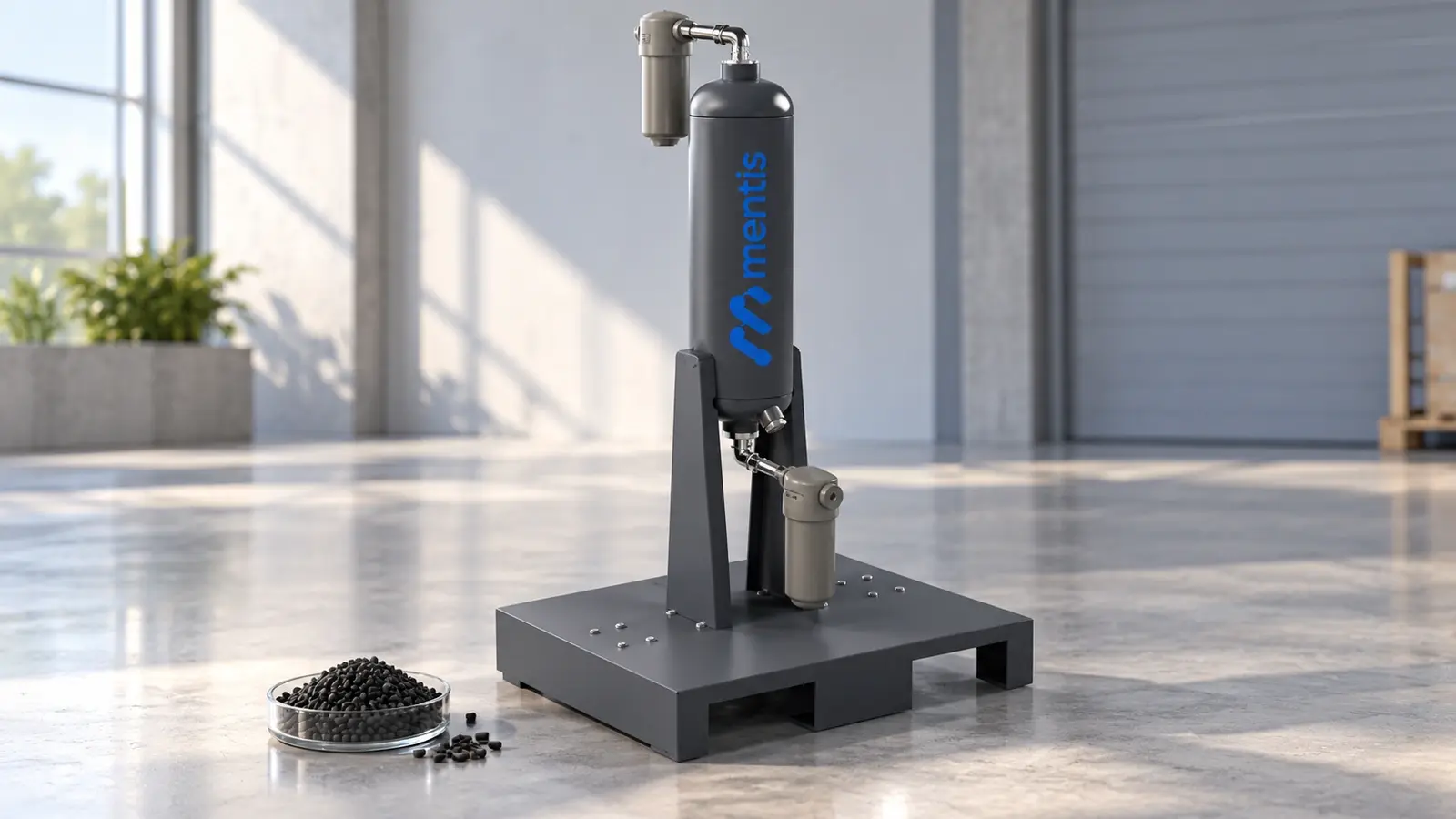
Oil contamination in compressed air does not always call for the same treatment device. Liquid oil and aerosols require suitable separation and coalescing filtration; oil vapour requires a different treatment step, such as activated carbon adsorption. A carbon tower should not be selected to compensate for missing pretreatment.
Depending on their design, cartridge filters may suit local applications or limited contamination loads. Towers containing more adsorbent may be considered for continuous operation and higher loads. Vessel size alone is not proof of performance: review usable adsorption capacity, permitted flow and the manufacturer's stated service-life conditions together.
Oil vapour concentration, temperature, humidity and annual operating hours influence the adsorbent load. Without inlet contamination data, do not assume a fixed replacement interval or removal percentage. Specify upstream drying and filtration conditions. Compressor design and lubricant information can also support the assessment.
Clarify the initial media or cartridge, replacement consumables, downstream particle filter, sampling points and service space. Compare quotations at the same net flow, outlet quality target and duty profile. Continuous production also requires a plan for supply during maintenance; bypassing treatment does not provide a reserve of treated air.
Define the total oil target at the point of use and how it will be verified. An oil vapour measurement is not automatically a total oil assessment. Outlet measurements and the manufacturer's maintenance plan support ongoing evaluation. Meeting the oil limit alone does not establish that air is dry, sterile or suitable for breathing.
Share flow, pressure, inlet temperature, operating hours and required oil quality with Mentis Engineering to define a carbon tower solution and quotation scope for your process.