
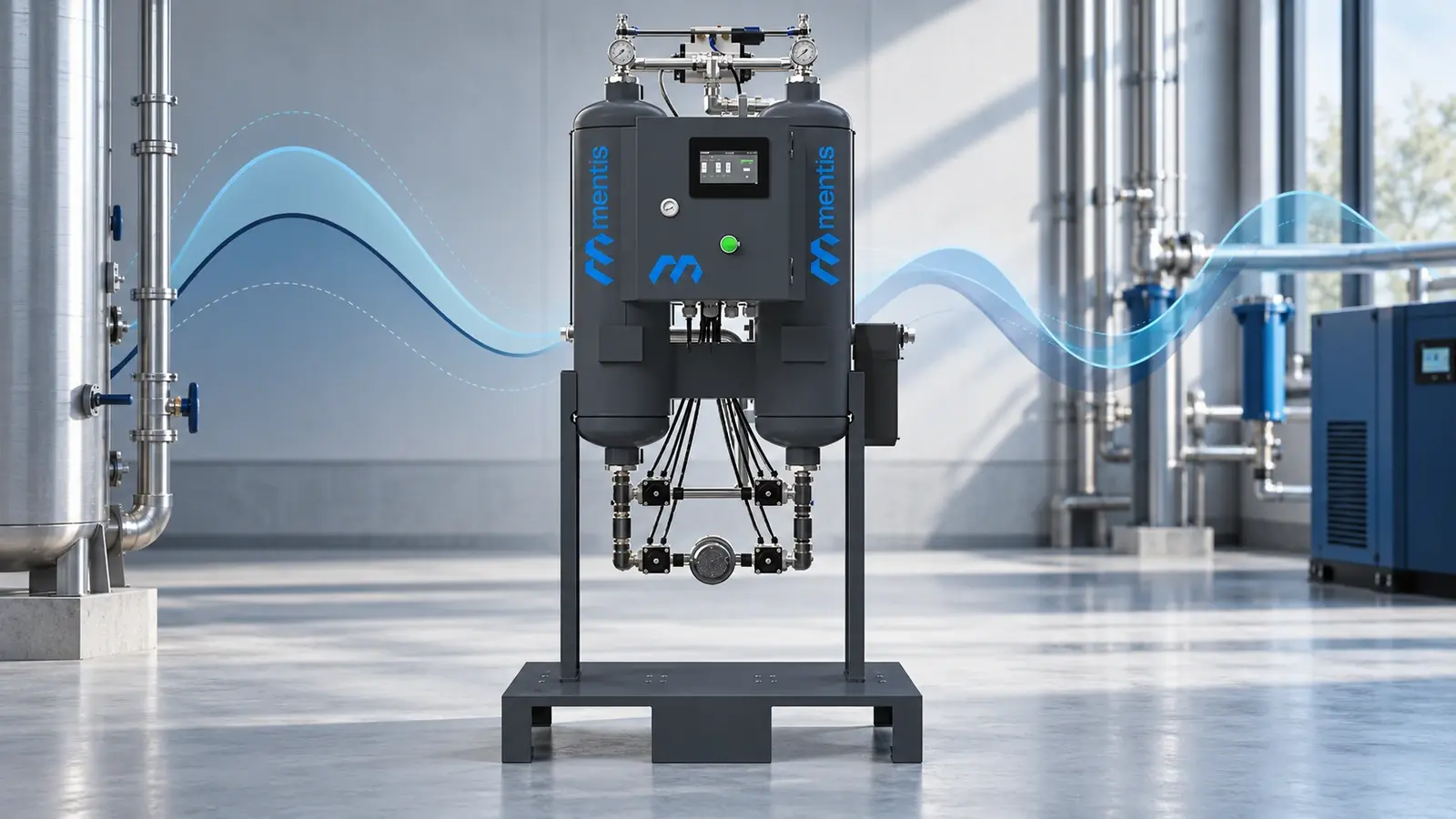
A timer-controlled twin-tower dryer switches beds according to a predefined programme. With dew-point-dependent control, suitable sensing and logic can extend adsorption while maintaining dry-air quality. The other tower must still complete its required regeneration, cooling and repressurisation stages. Adding a sensor does not remove these requirements.
Lower flow or cooler, drier inlet air can reduce the water load on the adsorbent. During such periods, unnecessary switching and regeneration consumption may be reduced. At high, continuous load, opportunities to extend the cycle may be limited. Savings are not identical across plants; the effects on purge air, heaters and blowers must be confirmed for the specific dryer design.
Pressure dew point is not numerically identical to the dew point of a sample expanded to atmospheric pressure. Sensor position, sample flow, measurement pressure, response time and calibration affect the control decision. The switching threshold should not wait until process quality has already been exceeded; an appropriate margin is needed for measurement delay.
Define the manufacturer-approved fallback operating logic and alarms for sensor failure or loss of communication. Do not shorten minimum regeneration times or defeat interlocks to save energy. During acceptance, record outlet dew point, cycle durations and total energy at different loads. Compare results for the same net dry-air requirement. Less frequent tower switching alone is not proof of successful optimisation.
Assess the existing dryer controls and load profile with Mentis Engineering to identify an appropriate monitoring or control improvement.