
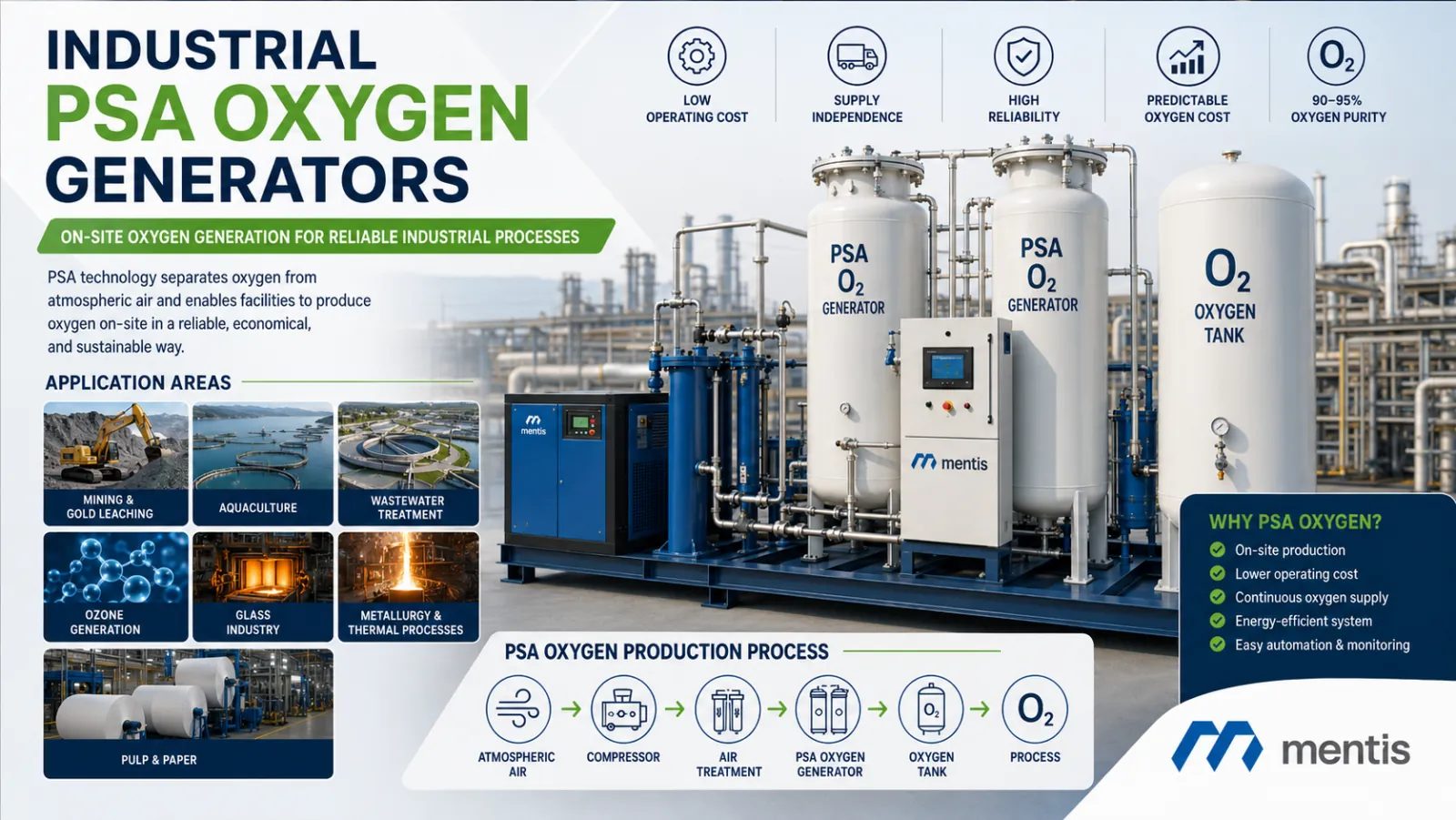
A PSA oxygen generator is an on-site oxygen generation system that separates nitrogen from compressed atmospheric air and produces oxygen-enriched product gas.
PSA stands for Pressure Swing Adsorption.
A typical process is:
Atmospheric Air → Compressor → Air Treatment → PSA Oxygen Generator → Oxygen Receiver → Process
Depending on the application and system design, industrial PSA systems are commonly designed to produce approximately 90–95% oxygen.
PSA oxygen generators typically use Zeolite Molecular Sieve – ZMS.
Compressed and treated air enters adsorption vessels where nitrogen is preferentially adsorbed by the zeolite. Oxygen-enriched gas passes through the system as the product gas.
In a twin-vessel design, one vessel produces oxygen while the other regenerates.
PLC-controlled cycles enable continuous oxygen production.
Oxygen can improve oxidation and leaching processes in mining operations.
For mines with continuous oxygen demand, on-site PSA generation can reduce reliance on transported oxygen.
Dissolved oxygen is one of the key parameters affecting fish health and production density.
PSA oxygen is widely applicable to:
Biological wastewater processes require oxygen for microorganisms.
Oxygen-enriched aeration can provide higher oxygen transfer capacity in selected applications.
Using oxygen instead of ambient air as the feed gas can support higher ozone concentration and more efficient ozone generation.
PSA systems can provide a continuous oxygen feed for ozone generators.
Oxygen enrichment and oxy-fuel combustion can be used to improve combustion performance and optimize furnace operation.
Industrial oxygen can be used for:
Oxygen may be used in bleaching, oxidation and selected chemical processes.
On-site PSA oxygen generation can:
The principal inputs become:
Atmospheric Air + Electrical Energy
The most economical solution depends on the process.
A meaningful comparison should consider:
For facilities with high and continuous oxygen demand, PSA can offer a strong economic alternative.
Important design parameters include:
Flow + Purity + Pressure should always be evaluated together.
A PSA oxygen generator produces oxygen-enriched gas by adsorbing nitrogen from compressed atmospheric air.
Typical applications include mining, aquaculture, wastewater treatment, ozone generation, glass manufacturing, metallurgy and pulp & paper.
Yes. Properly treated compressed air is the primary feed for PSA technology.
It can be particularly attractive for continuous and high oxygen consumption. The actual payback should be calculated according to oxygen purchase price, electricity cost, operating hours and total investment.
At Mentis Engineering, we approach oxygen generation as a complete engineered system:
Compressor + Air Receiver + Drying & Filtration + PSA Oxygen Generator + Oxygen Receiver + Analyzer + Automation + Booster, if required
Share your oxygen consumption, required purity, operating pressure and annual operating hours.
Our engineering team can evaluate your PSA capacity, energy consumption, estimated oxygen production cost per Nm³ and investment ROI.