
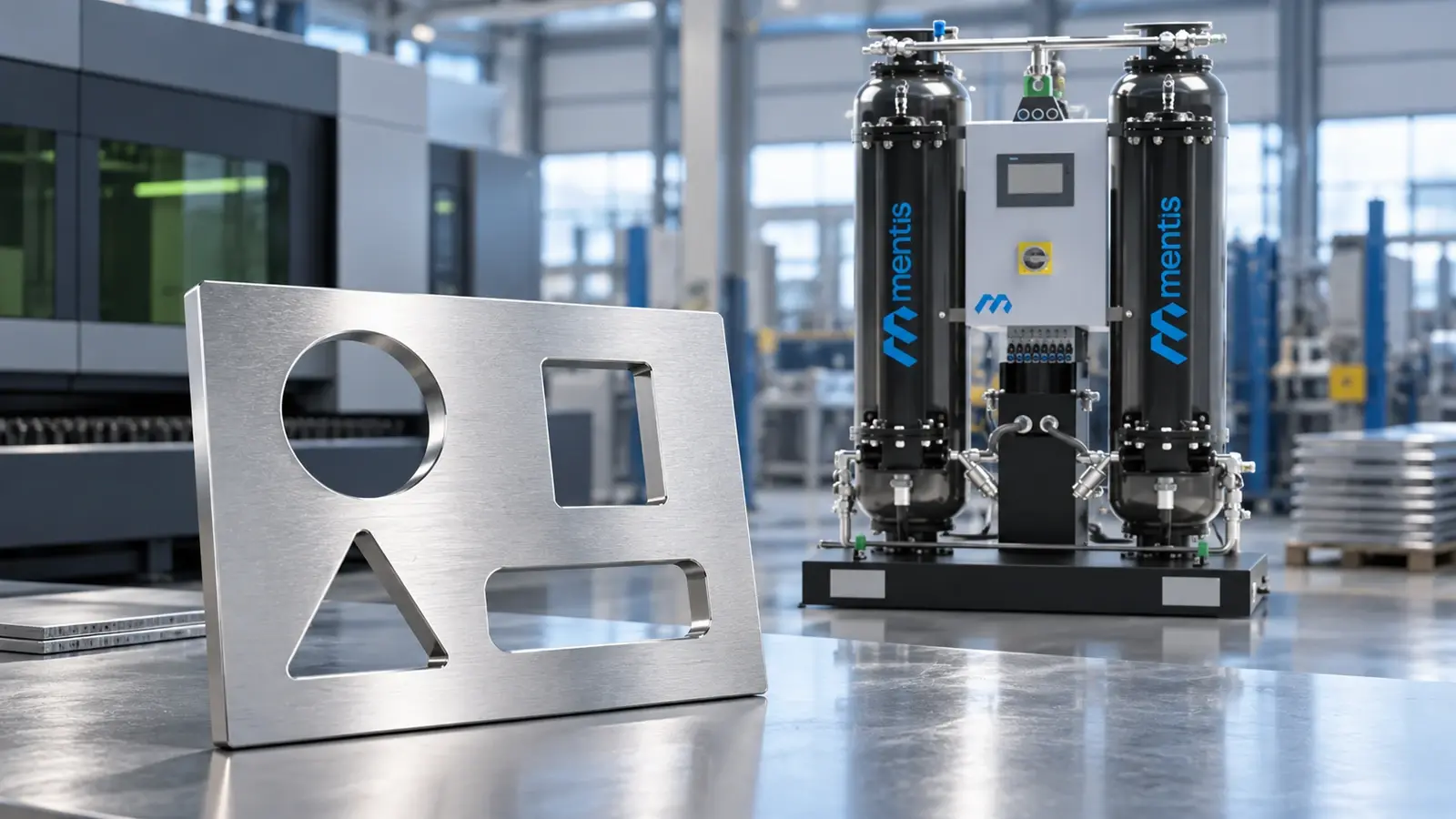
Nitrogen acts as an assist gas that removes laser-melted metal from the kerf and limits oxidation around the cut. Oxygen and other contaminants in the gas can affect the required edge appearance, particularly on demanding finishes. Purity is only one variable: material, nozzle, focus, speed and gas delivery also need to be assessed.
Nitrogen at 99.9% and above describes a selection range, not a universal acceptance criterion. Stainless steel jobs requiring a bright edge may need higher purity. The machine manufacturer's gas specification and the customer's part acceptance requirements determine the target. Excessive purity can affect capacity and cost, while insufficient quality can cause additional cleaning or rejected parts.
If the actual nitrogen mole or volume fraction is specified as 99.9%, the remaining total fraction is 0.1%; it cannot automatically be treated as oxygen alone. Some generation systems express quality through residual oxygen. Clarify how nitrogen, argon and residual oxygen are reported and which limits apply to moisture and other contaminants.
Available flow from a PSA nitrogen generator depends on target purity and operating conditions. Do not directly compare catalogue flows stated at different purity levels. Match peak laser consumption, delivery pressure, booster capacity and buffer storage together. Meeting quality and pressure at the point of use requires more than achieving a generator outlet specification.
Test suitable purity options on the same material and thickness with recorded machine settings. Document edge colour, burrs, dimensional accuracy and preparation required before welding or coating. Verify gas analysis at a representative point. Compare gas, electricity, maintenance, secondary processing and cost per accepted part when assessing quotations.
For nitrogen laser cutting at 99.9% purity and above, share your material, thickness, machine model, quality requirement and consumption with Mentis Engineering. Request flow and pressure assessment at the target purity.