
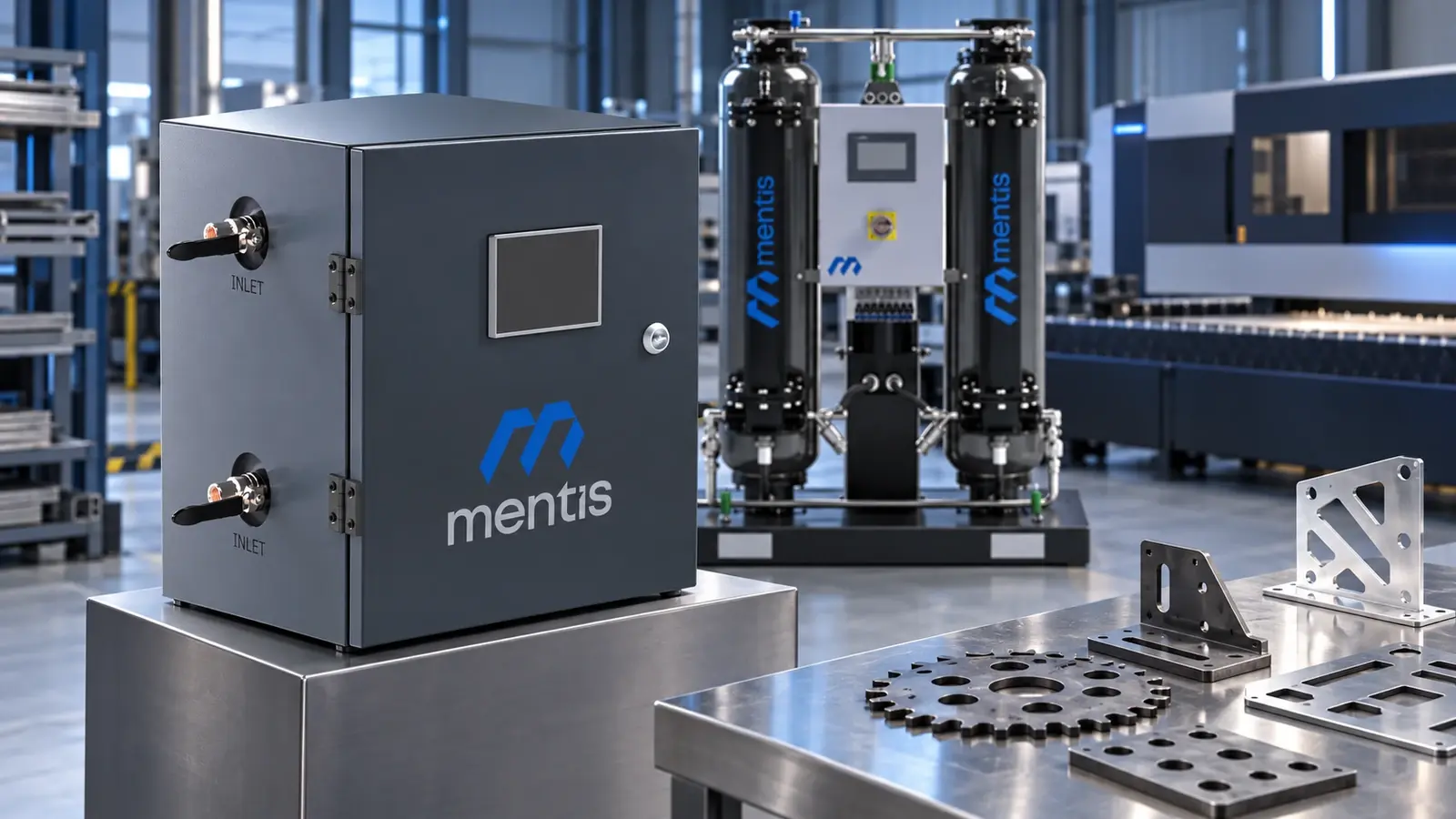
Mixed gas laser cutting combines nitrogen and oxygen in controlled proportions. A nominal mixture of 90% N₂ and 10% O₂ by volume is a process recipe to evaluate, not a guarantee of the best result for every machine or material. Suitability depends on alloy, thickness, laser power, cutting settings and subsequent manufacturing operations.
Mixture composition describes the intended nitrogen and oxygen proportions. Purity also addresses unwanted constituents in the gas. Setting two inlet flow rates to a 90/10 ratio does not deliver exactly 90% N₂ / 10% O₂ when the feed gases contain other components. Evaluate feed gas analyses and measured outlet composition together.
Match nitrogen generation, the oxygen source, gas mixer and any pressure boosting to the same process duty. Specify the adjustment range and accuracy for the actual mixer offered. Inlet pressures, minimum and maximum flow, sudden demand changes and any storage volume affect composition stability. Catalogue capacity alone is insufficient for system selection.
Compare pure nitrogen, oxygen and suitable mixed gas options using the same part and documented machine settings. Assess cutting time, burrs, edge oxidation, dimensional accuracy and subsequent cleaning. Mixtures can improve processing performance in certain applications, but speed or savings claims require sample results and production data rather than a universal percentage.
Specify target recipes, feed gas quality, delivery pressure, peak flow and operating hours. Establish the appropriate analyser, sampling location, stabilisation time after recipe changes and gas quality permissive signals. Include generation or gas supply, electricity, maintenance and secondary processing when comparing total costs.
For a 90% N₂ / 10% O₂ or adjustable mixed gas solution, share your material, thickness, laser model and consumption data with Mentis Engineering and request a system assessment supported by sample validation.