
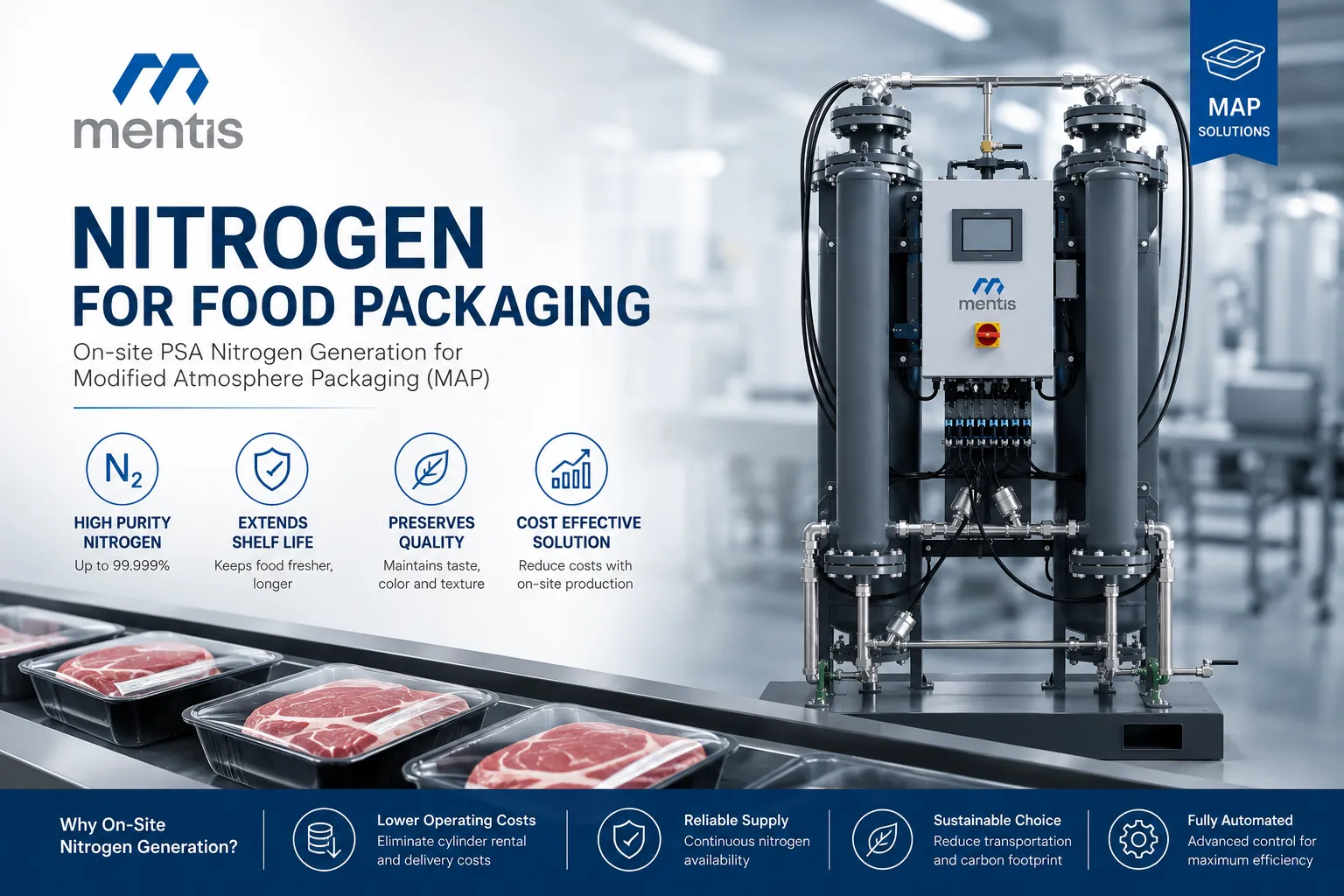
MAP stands for Modified Atmosphere Packaging.
The composition of gas inside the package is modified according to the requirements of the food.
Common MAP gases include:
Nitrogen can help:
The correct gas mixture depends on the product.
Typical applications include:
A PSA nitrogen generator produces nitrogen-rich gas from compressed atmospheric air.
Typical process:
Atmospheric Air
→ Compressor
→ Air Receiver
→ Dryer
→ Precision Filtration
→ PSA Nitrogen Generator
→ Nitrogen Receiver
→ Purity Analysis
→ MAP Packaging Line
PSA uses Carbon Molecular Sieve – CMS to preferentially adsorb oxygen and selected air components.
There is no single universal purity specification for all food packaging applications.
The required N₂ quality should be determined according to:
A key engineering principle is:
Do not generate unnecessarily high purity. Generate the purity the process actually requires.
In PSA systems:
N₂ Purity ↑
→ Recovery ↓
→ Compressed Air Demand ↑
→ Energy ↑
→ Cost per Nm³ ↑
Sizing should consider:
If a packaging machine consumes:
250 NL/min
then:
250 × 60 / 1,000 = 15 Nm³/h
Three simultaneously operating lines:
15 × 3 = 45 Nm³/h
Peak demand and design margin must then be evaluated.
| Criterion | PSA On-Site | Cylinders / Bundles |
|---|---|---|
| Source | Atmospheric air | External supplier |
| Production | On-site | External |
| Deliveries | Significantly reduced | Continuous |
| Cylinder handling | None | Required |
| Main OPEX | Electricity + maintenance | Gas + rental + logistics |
| Continuous demand | Strong application | Can become expensive |
| Supply independence | High | Low |
A correct LIN comparison should include:
PSA operating cost mainly consists of:
Electricity + Maintenance + Consumables
The most useful comparison is therefore:
€/Nm³ N₂
Annual Current Nitrogen Cost = Annual N₂ Consumption × Delivered N₂ Cost
Add logistics and rental.
Then:
Annual PSA OPEX = Electricity + Maintenance + Consumables
Annual Savings = Current N₂ Cost – PSA OPEX
Simple Payback = PSA Investment / Annual Savings
High-utilization packaging plants operating multiple shifts can be particularly attractive for on-site generation.
Nitrogen helps displace oxygen and create a controlled atmosphere around the food.
Modified Atmosphere Packaging changes the gas composition inside a package according to product requirements.
Yes, when the system is engineered to meet the required nitrogen purity, flow, pressure and gas quality.
It depends on the food, packaging line, residual oxygen target and quality requirements.
Industrial PSA systems can be engineered for continuous operation.
Mentis Engineering treats MAP nitrogen as a complete process system:
**Compressor
Share your nitrogen consumption, number of packaging lines, operating hours and pressure requirements.
Our team can calculate:
PSA Capacity + Compressor Requirement + Energy Consumption + N₂ Cost per Nm³ + Annual Savings + ROI
Mentis Engineering – On-Site Nitrogen Generation for Food Packaging