
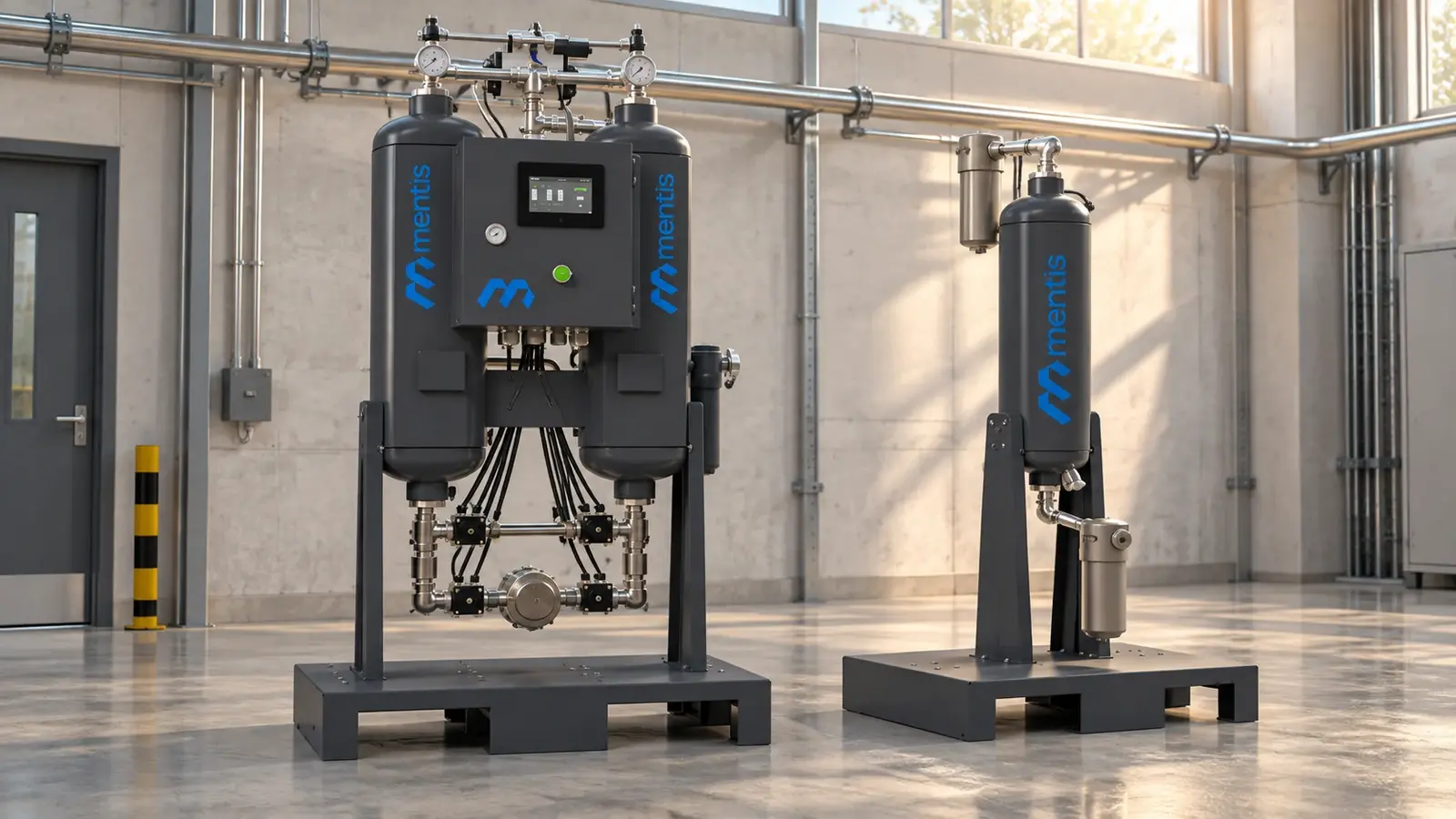
In some installations, suitable drying and purification may achieve the required air quality while retaining the existing compressor. Feasibility depends on inlet contamination, capacity, pressure and process requirements. Treatment does not convert an oil-lubricated compression mechanism into an oil-free design; it targets defined quality limits at the point of use.
A request for an oil-free desiccant dryer usually means a system controlling both moisture and oil. The primary duty of the desiccant bed is water vapour removal. Pretreatment addresses oil aerosols, suitable adsorption addresses oil vapour, and downstream filtration addresses media dust. The dryer alone does not prove compliance with a total oil target.
Review the compressor, aftercooler, drains, filter grades, dryer and distribution piping. Calculate net flow after peak demand and regeneration requirements are considered. Added treatment pressure drop must leave enough pressure at the most distant consumer. Contaminated piping and shared connections can recontaminate treated air and belong within the retrofit assessment.
Suitable serviceable equipment may be retained while a separate carbon tower or drying stage is added. Space and coordinated operation may favour a dryer with integrated carbon adsorption. Required pretreatment and final equipment order must follow the manufacturer's design. Include maintenance access, safe isolation and the available production shutdown window.
Verify net delivery, use pressure, pressure dew point, total oil and required particle limits under defined conditions. Measurements should represent actual production loading. Include maintenance and repeat testing in the handover scope. Product-contact food or pharmaceutical applications require separate evaluation of additional hygiene requirements.
Share your existing compressor and network details, process needs and available quality reports with Mentis Engineering to plan the oil-free dry air retrofit and its acceptance targets.