
Gold leaching is a hydrometallurgical process used to dissolve gold from ore into a liquid phase before downstream recovery.
In conventional cyanide leaching, oxygen is an important component of the gold dissolution reaction.
Under suitable process conditions, increasing available dissolved oxygen may help:
However, oxygen demand varies considerably from one ore body to another.
Oxygen is used in gold leaching because it participates in the cyanidation reaction and can support faster gold dissolution when dissolved oxygen is limiting. PSA oxygen generators produce oxygen directly at the mine site, reducing dependence on liquid oxygen deliveries.
Atmospheric air contains only about:
21% oxygen
while industrial PSA oxygen systems can provide approximately:
90–95% O₂
for suitable process applications.
Using oxygen-enriched gas instead of air may be particularly useful where:
However:
More oxygen does not automatically mean better gold recovery.
Oxygen demand should be evaluated together with:
Ore Mineralogy + Sulfide Content + Particle Size + Slurry Properties + Leach Chemistry + Mixing + Mass Transfer
PSA stands for:
Pressure Swing Adsorption
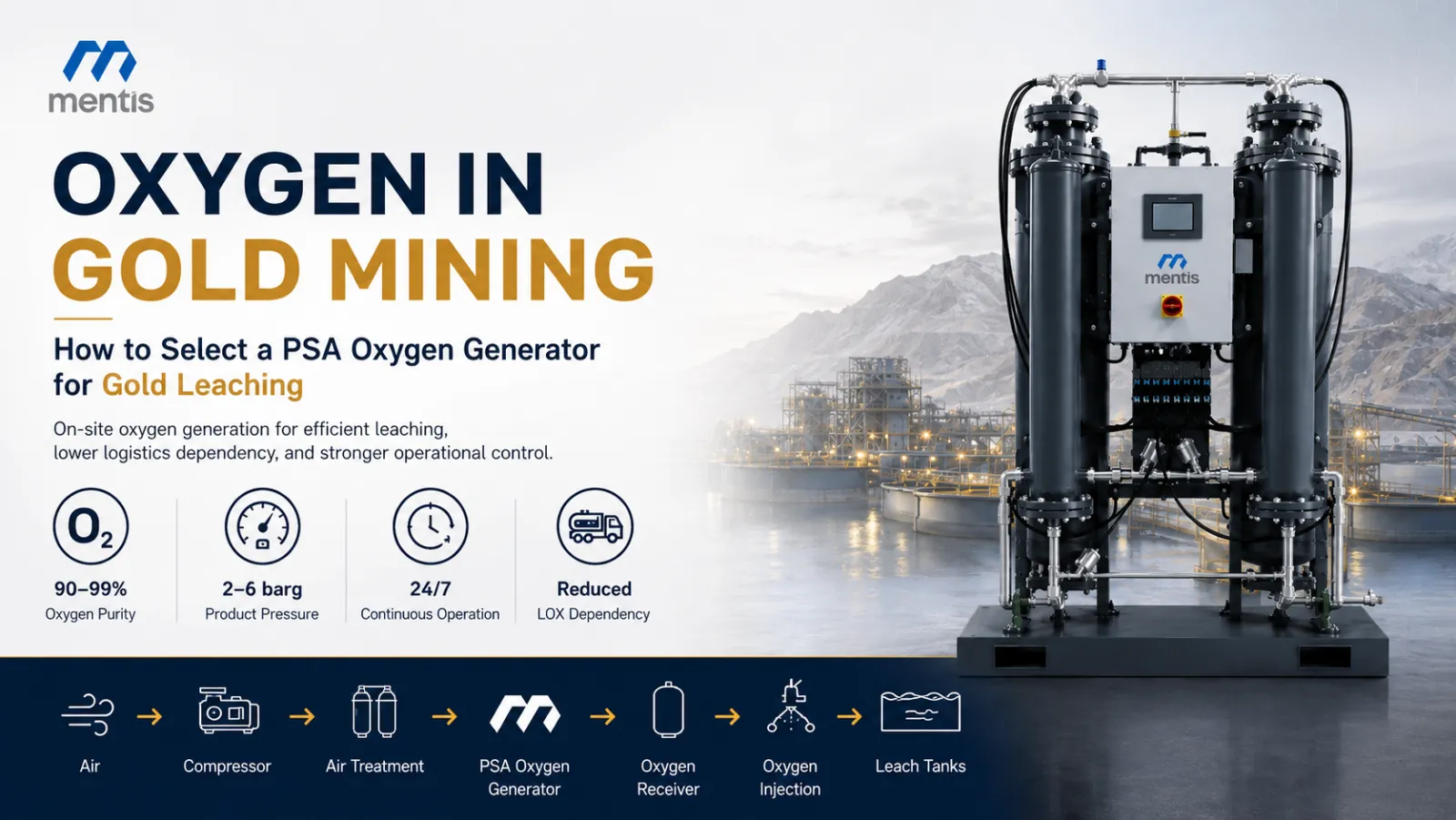
A typical mining oxygen plant includes:
Atmospheric Air
→ Air Compressor
→ Air Receiver
→ Drying & Filtration
→ PSA Oxygen Generator
→ Oxygen Receiver
→ O₂ Analyzer
→ Pressure / Flow Control
→ Leach Tank / Oxygen Injection System
PSA oxygen systems typically use a zeolite molecular sieve to selectively adsorb nitrogen from compressed air.
The resulting oxygen-enriched product gas is then supplied to the leaching process.
Many gold leaching applications do not require cryogenic oxygen purity.
For suitable cyanidation processes, PSA oxygen in the approximate range of:
90–95% O₂
may be sufficient.
The actual requirement should be confirmed by process engineering and metallurgical testwork.
Do not specify the highest possible purity. Specify the purity the process actually requires.
Unnecessarily high purity may increase:
The generator should not be selected only from plant throughput.
The following data should be considered:
A simplified preliminary formula is:
O₂ Requirement (kg/h)
= Ore Throughput (t/h) × Specific O₂ Demand (kg/t)
Then convert to Nm³/h.
At normal reference conditions:
1 Nm³ O₂ ≈ 1.43 kg O₂
Therefore:
O₂ Flow (Nm³/h)
≈ O₂ Demand (kg/h) / 1.43
Assume:
Ore Throughput = 200 t/h
Specific oxygen demand:
0.5 kg O₂/t
Hourly oxygen demand:
200 × 0.5 = 100 kg/h
Approximate gas flow:
100 / 1.43 ≈ 70 Nm³/h O₂
However, the PSA generator should not automatically be selected as exactly 70 Nm³/h.
Additional considerations include:
This example illustrates the sizing methodology only. Real oxygen demand must be verified by metallurgical testwork and plant data.
Because every ore body is different.
Oxygen can be consumed not only by the desired gold dissolution reaction but also by:
Therefore, there is no technically correct universal rule such as:
X tons/day = Y Nm³/h oxygen generator
without considering ore characteristics.
The amount of oxygen supplied to the plant is not the same as the amount effectively transferred into the slurry.
Therefore:
Oxygen Generator Capacity ≠ Effective Process Oxygen Utilization
A 100 Nm³/h oxygen system can perform poorly if the injection system has:
Better oxygen utilization may be achieved through:
The PSA system and oxygen injection system should therefore be evaluated as one integrated process.
The required product pressure depends on:
A typical process range may be:
2–6 barg
depending on the application.
Unnecessarily high pressure increases:
Compressor Energy ↑
OPEX ↑
Payback Period ↑
Therefore, oxygen pressure should be optimized for the actual injection system.
Many gold mines operate at elevated altitudes.
As altitude increases:
Therefore, a PSA system selected for sea-level conditions may require derating or resizing at altitude.
Important design parameters include:
Site Altitude – meters above sea level
Mining sites may be exposed to:
Therefore, the oxygen plant may require:
Advantages can include:
Particularly suitable for:
A containerized package can integrate:
Compressor + Air Treatment + PSA + Controls + HVAC + Electrical Distribution
This can reduce on-site installation work.
Gold leaching plants often operate continuously.
If oxygen supply is process-critical, system availability should be treated as a design parameter.
1 × 100%
Lower initial investment, but critical single-point failures must be evaluated.
2 × 50%
or:
2 × 60%
Provides modular operation.
For example:
3 × 50%
can provide greater availability during maintenance.
The correct philosophy depends on:
At remote mine sites, oxygen logistics can be a major operating issue.
**Oxygen Purchase
**Electricity
| Criterion | PSA On-Site O₂ | Liquid Oxygen |
|---|---|---|
| O₂ source | Atmospheric air | External gas plant |
| Production | Mine site | External |
| Tanker dependency | Very low | High |
| Cryogenic storage | Usually not required | Required |
| Main OPEX | Energy + maintenance | Gas + logistics |
| Remote site suitability | High | Logistics dependent |
| 24/7 operation | Very suitable | Suitable |
| Scalability | Can be modular | More supply/storage needed |
| Supply control | Mine operator | External supplier |
| Initial CAPEX | Higher | Can be lower initially |
The main electrical consumer is generally:
the air compressor.
Simplified calculation:
Annual Energy = Average System kW × Annual Operating Hours
Example:
Average power:
150 kW
Annual operation:
8,000 h/year
Annual energy:
150 × 8,000 = 1,200,000 kWh/year
At:
€0.10/kWh
annual electricity cost:
€120,000/year
This can then be divided by annual oxygen production to determine:
€/Nm³ O₂
Annual O₂ Consumption × Delivered Oxygen Price
plus:
Electricity + Maintenance + Consumables
External Oxygen Cost – PSA OPEX
PSA CAPEX / Annual Net Savings
High oxygen demand, 24/7 operation and remote logistics can significantly improve the economic case for PSA.
A PSA oxygen generator does not automatically guarantee a specific increase in gold recovery.
However, where dissolved oxygen is limiting, improving oxygen availability and transfer can support:
The expected benefit should be established using:
Metallurgical Testwork + Plant Data + Oxygen Mass Balance
No.
This guide mainly refers to:
cyanide / cyanidation gold leaching.
Alternative leaching chemistries may respond differently to oxygen.
Therefore:
“Gold leaching always requires maximum oxygen”
is not a technically valid statement.
Oxygen participates in the cyanidation reaction and can support gold dissolution kinetics when dissolved oxygen is limiting.
PSA oxygen in the approximate range of 90–95% O₂ may be suitable for many applications, subject to process requirements.
Yes. Industrial PSA systems can provide on-site oxygen for continuous gold leaching operations.
Based on ore throughput, specific oxygen demand, peak load, oxygen transfer efficiency, altitude and redundancy.
Yes. Compressor and PSA performance should be corrected for site altitude.
It can be particularly attractive for high, continuous consumption and remote mine sites.
Yes, when properly engineered with suitable air treatment, maintenance and redundancy.
No fixed percentage can be guaranteed. The impact depends on mineralogy, chemistry, dissolved oxygen and mass transfer.
Mentis Engineering approaches gold leaching oxygen as a complete engineered package:
**Air Compressor
Share these seven parameters:
Our engineering team can evaluate:
**PSA Capacity
Mentis Engineering – On-Site Oxygen Generation for Gold Mining
The most important question is not:
“What size oxygen generator should I buy?”
The correct question is:
“What is the real oxygen demand of my ore, and how can I generate that oxygen at the mine with the highest process availability and lowest total cost of ownership?”
A successful gold mining oxygen project requires:
Ore Mineralogy + Metallurgical Testwork + O₂ Mass Balance + PSA Sizing + Compressor Efficiency + Oxygen Transfer + Altitude Correction + Redundancy + TCO / ROI