
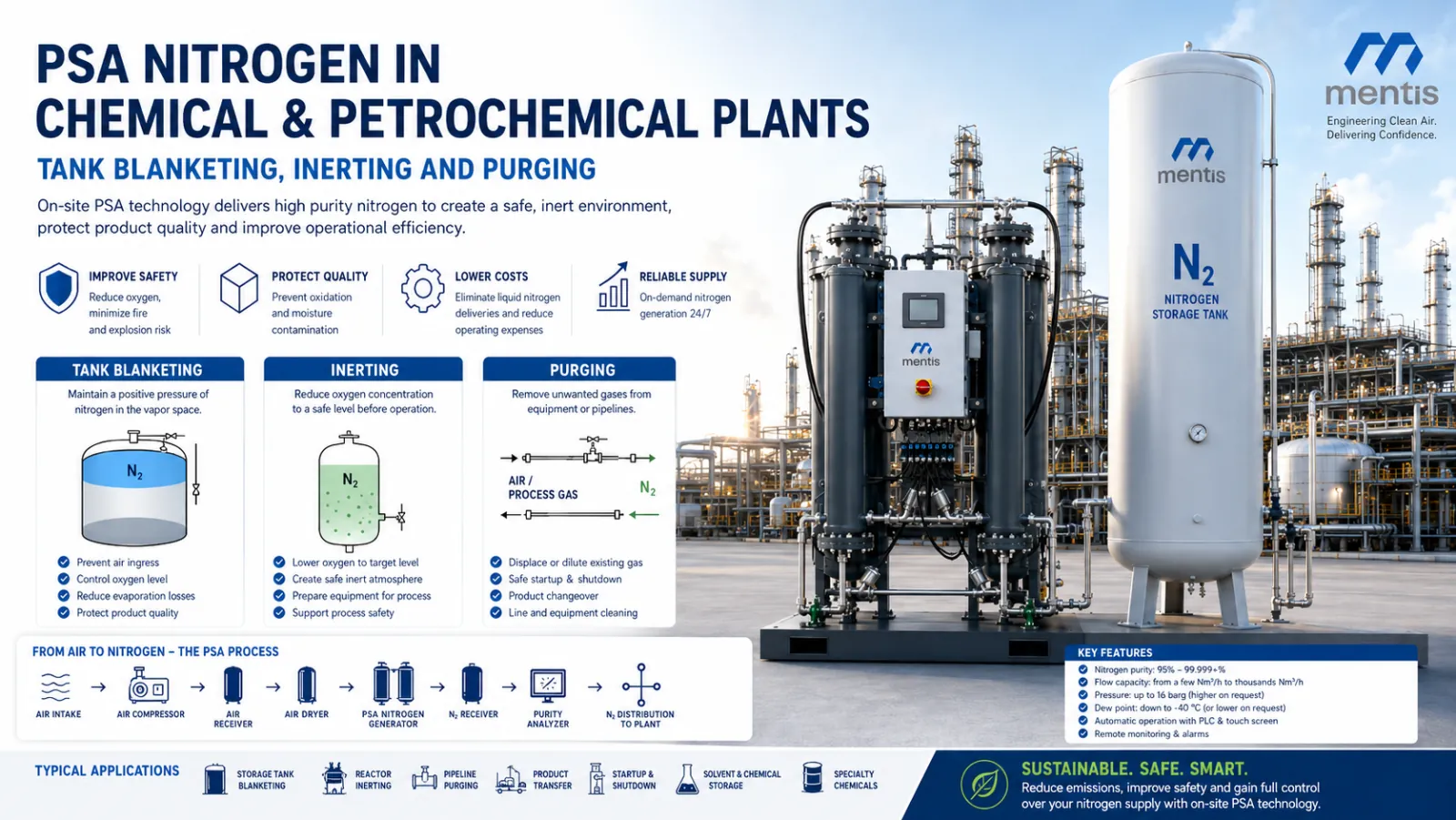
Typical applications include:
Nitrogen is used to reduce unwanted oxygen, air or process gases and create a controlled inert atmosphere around sensitive or flammable processes.
Tank blanketing maintains a controlled nitrogen atmosphere in the vapor space above a stored liquid.
It may help:
Tank blanketing should be engineered together with the tank's venting, pressure and vacuum protection philosophy.
Inerting reduces oxygen concentration inside equipment to a process-defined safe level.
The target O₂ concentration depends on:
There is no universal O₂ target for all chemical applications.
Purging replaces an existing gas atmosphere inside equipment or piping.
Applications include:
| Application | Main Purpose |
|---|---|
| Blanketing | Maintain an N₂ atmosphere |
| Inerting | Reduce oxygen concentration |
| Purging | Replace the existing gas |
| Padding | Maintain inert pressure above product |
| Pressurization | Apply N₂ pressure to equipment |
Atmospheric Air
→ Compressor
→ Air Receiver
→ Dryer
→ Precision Filtration
→ PSA Nitrogen Generator
→ N₂ Receiver
→ Purity Analyzer
→ Plant Nitrogen Header
PSA technology uses Carbon Molecular Sieve – CMS to produce nitrogen-rich gas from compressed air.
Depending on the process, nitrogen purity may range from approximately:
95% to 99.999%+ N₂
The correct specification should be based on the process oxygen limit.
In general:
N₂ Purity ↑
→ Recovery ↓
→ Air Demand ↑
→ Energy ↑
→ Cost per Nm³ ↑
Therefore, over-specifying purity can increase operating costs.
The main factors are:
A tank withdrawing 20 m³/h of liquid creates a corresponding vapor-space volume demand, but thermal effects and design margins must also be considered.
Nitrogen demand depends on:
A vessel's nitrogen requirement is not simply equal to its geometric volume.
Nitrogen pushes the existing gas out with minimal mixing.
Nitrogen mixes with the existing gas while concentration is progressively reduced.
The vessel is pressurized with nitrogen and then depressurized in controlled cycles.
The correct method depends on equipment design and process safety requirements.
PSA systems should not be sized only for average consumption.
For example:
Normal demand: 80 Nm³/h
but simultaneous purging may create:
220 Nm³/h peak demand
Possible solutions:
It can:
A complete system should specify:
For sensitive chemical processes, moisture may be just as critical as nitrogen purity.
Depending on site classification, projects may require:
Alternatively, the PSA plant can be installed in a safe area and connected to the process through a nitrogen ring main.
| Criterion | PSA On-Site N₂ | Liquid Nitrogen |
|---|---|---|
| Production | On-site | External |
| Tanker dependency | Low | High |
| Main OPEX | Energy + maintenance | Gas + logistics |
| Purity | Optimized for process | Very high |
| Supply control | Plant | Supplier |
| Continuous demand | Excellent candidate | Suitable |
Annual Savings = Existing Nitrogen Cost – PSA OPEX
Simple Payback = PSA CAPEX / Annual Net Savings
Continuous 24/7 blanketing applications can create a strong economic case for on-site generation.
Maintaining a controlled nitrogen atmosphere in the vapor space of a tank.
No. Inerting reduces oxygen to a target level; blanketing helps maintain the controlled atmosphere.
It depends on liquid withdrawal, thermal breathing, purge events and simultaneous demand.
It is process-specific. The allowable residual oxygen level is often more important than nominal nitrogen purity.
Yes, industrial PSA systems can be engineered for 24/7 operation.
We design:
Compressor + Air Treatment + PSA + N₂ Storage + O₂ Analysis + PLC/HMI + Ring Main + Pressure Control
as one integrated system.
Our team can calculate:
PSA Capacity + Compressor + Receiver + Energy + N₂ Cost per Nm³ + CAPEX/OPEX + ROI
Mentis Engineering – On-Site Nitrogen for Chemical & Petrochemical Plants