
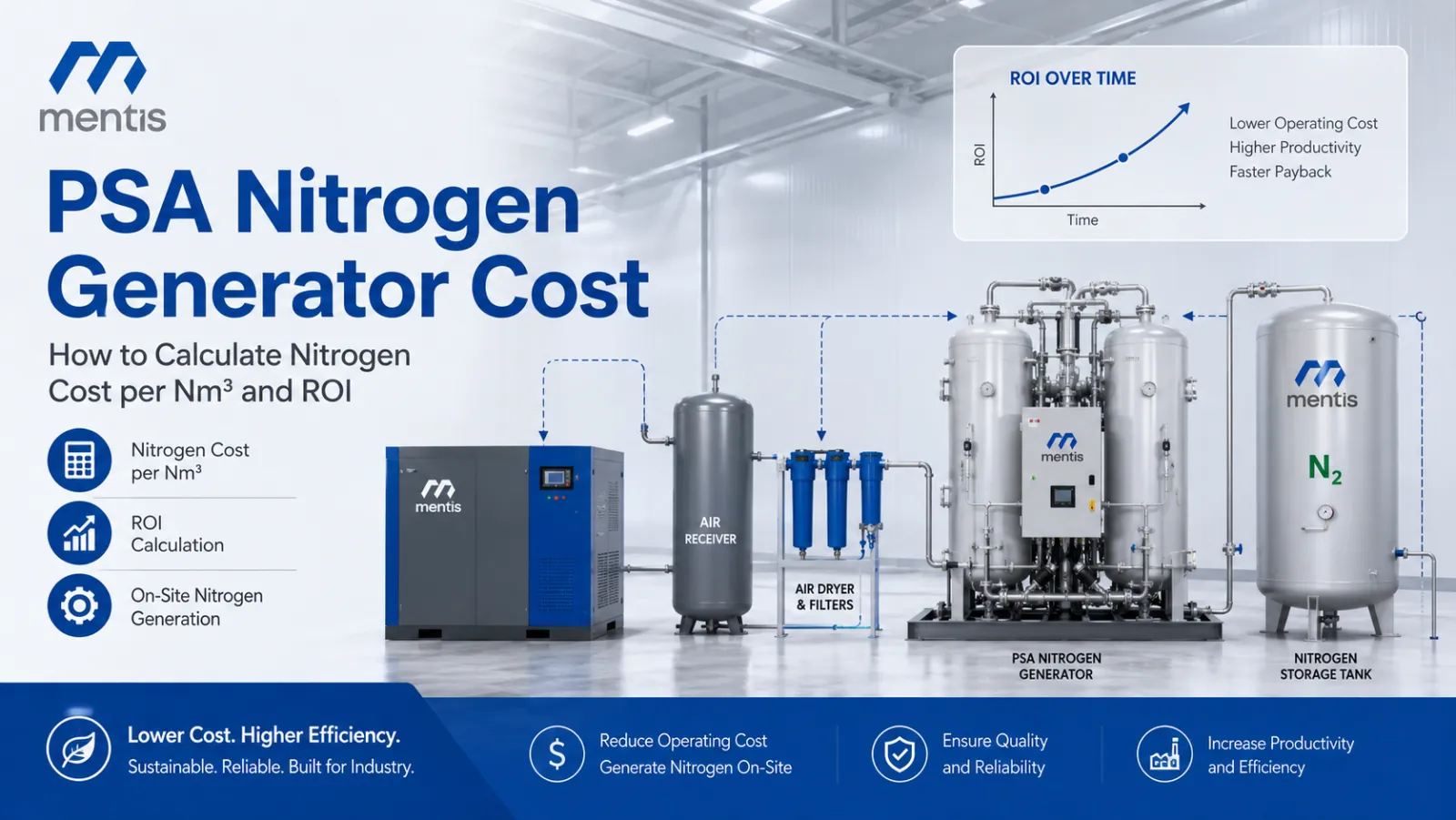
Short answer: there is no universal PSA nitrogen generator price.
A PSA system is an engineered on-site nitrogen plant.
The following parameters determine its cost:
The better question is:
“What will one Nm³ of nitrogen cost me, and how quickly will the system pay back?”
Typical process:
Atmospheric Air
→ Compressor
→ Air Receiver
→ Dryer & Filtration
→ PSA Nitrogen Generator
→ Nitrogen Receiver
→ Purity Analysis
→ Process
PSA systems use Carbon Molecular Sieve – CMS to preferentially adsorb oxygen and produce nitrogen-rich gas.
Depending on application, industrial systems can be engineered for a wide range of nitrogen purities.
In general:
N₂ Purity ↑
→ Nitrogen Recovery ↓
→ Compressed Air Demand ↑
→ Energy Consumption ↑
→ Nitrogen Cost per Nm³ ↑
Therefore, the most economical system is not necessarily the one producing the highest purity.
The correct target is:
The purity actually required by the process.
Nitrogen Flow × Annual Operating Hours
Example:
100 Nm³/h × 8,000 h = 800,000 Nm³/year
**Electricity
Annual PSA OPEX / Annual Nitrogen Production
Result:
€/Nm³ N₂
| Criterion | PSA On-Site | Liquid Nitrogen | Cylinders |
|---|---|---|---|
| Source | Atmospheric air | External | External |
| Production | On-site | External | External |
| Logistics | Very low | Tanker | High |
| Main OPEX | Energy + maintenance | Gas + logistics | Gas + logistics |
| Supply independence | High | Low | Low |
| Cost predictability | Higher | Supplier dependent | Supplier dependent |
| High continuous demand | Excellent candidate | Suitable | Usually inefficient |
Annual Nitrogen Consumption × Delivered Nitrogen Price
plus logistics and rental expenses.
Energy + Maintenance + Consumables
Existing Nitrogen Cost – PSA OPEX
Total PSA Investment / Annual Net Savings
Long operating hours and continuous nitrogen demand generally improve PSA economics.
High-purity and high-pressure nitrogen demand can make PSA + booster solutions attractive.
Continuous nitrogen consumption for modified atmosphere packaging is a common on-site application.
Applications include:
High-purity N₂ is commonly required in controlled atmosphere processes.
Nitrogen can provide controlled furnace atmospheres.
Purging and inerting can create significant nitrogen demand.
The compressor is typically the largest electrical consumer.
Poor selection can lead to:
**Higher Energy Cost
PSA and compressor sizing should therefore be treated as one integrated engineering problem.
Not necessarily.
Compare:
CAPEX + OPEX + TCO
rather than CAPEX alone.
TCO includes:
Flow, purity, pressure, compressor requirements, operating hours, air treatment, storage, automation and booster options.
Divide total annual PSA operating expenses by annual nitrogen production.
Generally yes, because compressed-air demand typically rises as purity increases.
It can be for high and continuous consumption, but a site-specific ROI calculation is required.
Properly engineered industrial PSA systems can be designed for continuous operation.
Yes. High-pressure booster systems can be added when required.
Mentis Engineering evaluates the entire system:
**Compressor
Share your nitrogen demand, purity, operating pressure, electricity cost and current nitrogen purchasing cost.
Our engineering team can calculate:
PSA capacity + compressed-air requirement + energy consumption + nitrogen cost per Nm³ + annual savings + ROI