
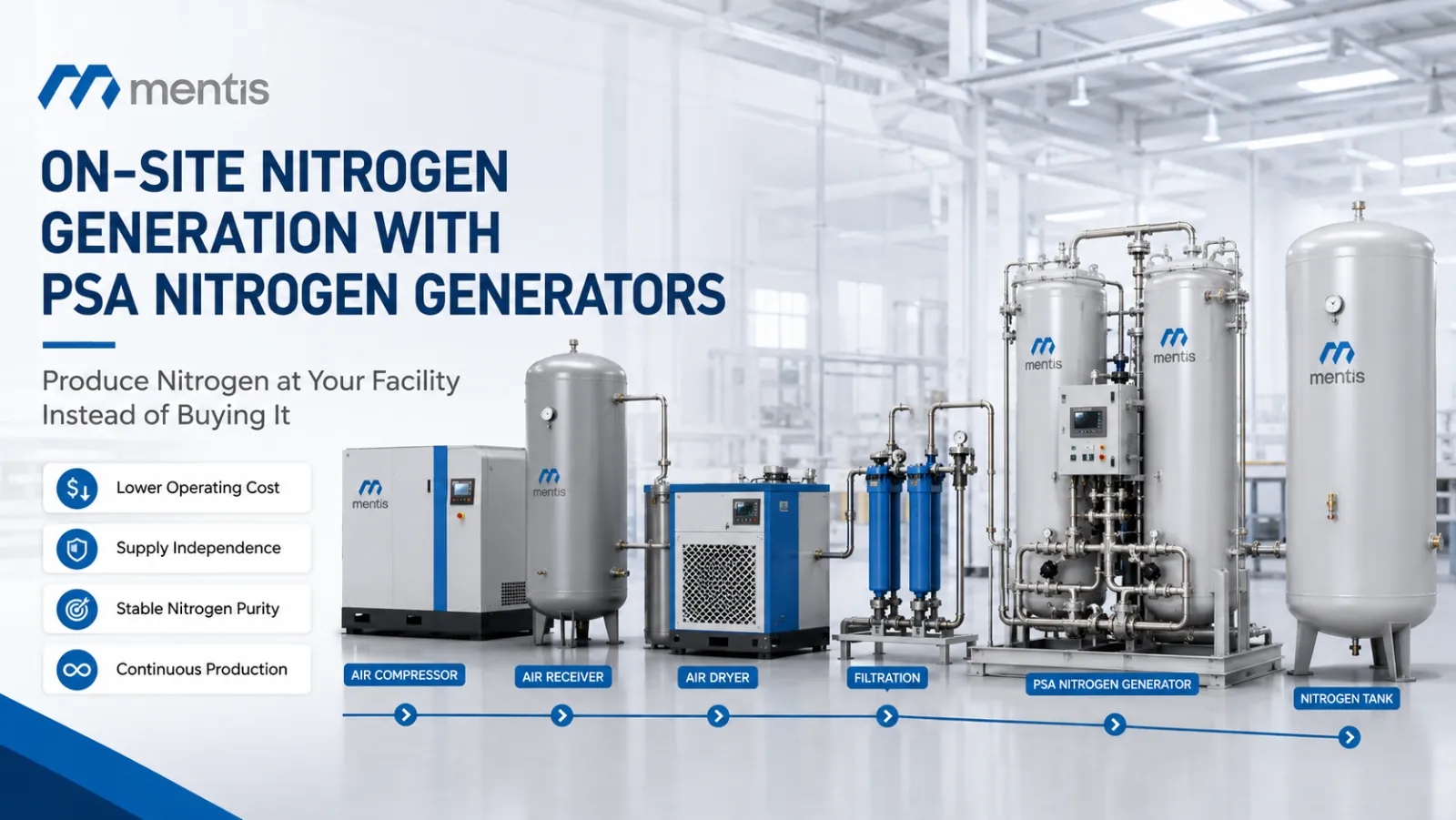
A PSA nitrogen generator is an on-site gas generation system that separates oxygen from compressed atmospheric air to produce nitrogen-rich gas.
PSA stands for Pressure Swing Adsorption.
Atmospheric air contains approximately 78% nitrogen and 21% oxygen. PSA technology does not create a new gas; it separates the nitrogen already present in the air and delivers it at the purity required by the process.
Therefore, the main inputs become:
Atmospheric Air + Electrical Energy
PSA nitrogen generators generally use Carbon Molecular Sieve – CMS.
When compressed and properly treated air enters the adsorption vessel, oxygen, water vapor and certain other gas molecules are adsorbed by the CMS faster than nitrogen. Nitrogen-rich product gas then exits the vessel.
A typical process configuration is:
Atmospheric Air
→ Air Compressor
→ Air Receiver
→ Dryer & Filtration
→ PSA Nitrogen Generator
→ Nitrogen Receiver
→ Purity Analysis
→ Process
PSA systems typically contain two adsorption vessels. While one vessel produces nitrogen, the other regenerates. PLC-controlled cycles allow continuous nitrogen production.
On-site nitrogen generation means producing the nitrogen required by an industrial process directly at the facility instead of continuously purchasing it from an external gas supplier.
Traditional nitrogen supply methods can include:
With a PSA system, nitrogen is produced close to the point of use.
This model becomes particularly attractive for facilities with regular and high nitrogen consumption.
Instead of transporting nitrogen from an external gas plant, the gas is generated directly on-site.
This can significantly reduce the need for delivery scheduling and gas inventory management.
Delays in tanker, cylinder or bundle deliveries can affect production.
On-site generation provides businesses with greater control over their nitrogen supply.
The main operating costs of a PSA system are typically:
electricity + maintenance + filters and consumables
This can reduce exposure to fluctuations in gas prices, transportation and logistics costs.
Not every application requires 99.999% nitrogen.
PSA systems can be engineered for different operating points, typically from approximately 95% up to 99.999% N₂ and higher, depending on the application.
Selecting the correct purity is critical for energy efficiency.
When nitrogen demand increases, properly designed systems can often be expanded with additional generators or capacity modules.
Nitrogen purity affects not only product quality but also the energy efficiency of a PSA system.
In general, as nitrogen purity increases:
Nitrogen Recovery ↓
Compressed Air Demand ↑
Energy Consumption ↑
Therefore, the correct engineering philosophy should not be:
“Produce the highest possible purity.”
It should be:
“Produce exactly the purity required by the process as efficiently as possible.”
If an application can safely operate with 99.5% nitrogen, unnecessarily producing 99.999% nitrogen may increase the energy consumption of both the compressor and PSA system.
High-purity and, where required, high-pressure nitrogen is used for stainless steel and aluminum cutting to minimize oxidation.
Nitrogen can be used for modified atmosphere packaging, tank blanketing and reducing product contact with oxygen.
Common applications include tank inerting, blanketing, purging and process safety.
Nitrogen is used in furnaces and processes requiring controlled atmospheres.
High-purity nitrogen may be required for sensitive manufacturing, soldering and controlled atmosphere applications.
Nitrogen can be used for process inerting, storage and specific manufacturing stages.
Typical applications include extrusion, foaming and controlled process atmospheres.
Nitrogen is an important process gas for purging, inerting, pressurization and maintenance operations.
Correct generator selection should not be based only on the question:
“How many Nm³/h of nitrogen do I need?”
The following parameters should be evaluated together:
In particular, flow + purity + pressure must be evaluated together.
PSA generator performance depends directly on inlet compressed air quality.
Compressor air may contain:
These contaminants can adversely affect adsorbent performance and system reliability.
Therefore, a properly engineered PSA system should be considered as a complete package:
compressor + air receiver + dryer + precision filtration + PSA generator
Even the best nitrogen generator cannot deliver optimum long-term performance if the compressed air preparation system is inadequate.
| Criterion | PSA On-Site Generation | Liquid Nitrogen |
|---|---|---|
| Nitrogen source | Atmospheric air | External gas plant |
| Production | On-site | External |
| Tanker requirement | None / low | Required |
| Cryogenic tank | Not normally required | Usually required |
| Electricity consumption | Yes | Low at the facility |
| Purity | Selected according to process | Very high |
| Gas purchasing | Can be greatly reduced | Continuous |
| Logistics dependency | Low | High |
| Capacity expansion | Can be modular | Supply/storage must increase |
| Main OPEX | Electricity + maintenance | Gas + logistics |
PSA is not automatically the most economical solution for every facility.
However, for nitrogen consumers operating at high, continuous and predictable demand, on-site generation can be a strong economic alternative.
A PSA feasibility study should not evaluate only the generator purchase price.
Typical costs can include:
**Gas Purchase
Typical costs include:
**Electricity
The most meaningful comparison should therefore be made in:
€/Nm³ N₂
or the relevant local currency per Nm³.
As annual nitrogen consumption and operating hours increase, the economic potential of PSA typically becomes more significant.
The payback period depends on:
Therefore, stating one universal ROI period is technically incorrect.
A basic approach is:
Annual Savings = Existing Annual Nitrogen Cost – PSA Annual Operating Cost
Payback Period = Total PSA Investment / Annual Net Savings
A PSA nitrogen generator separates oxygen and other components from atmospheric air by adsorption, producing nitrogen-rich gas.
Depending on system design and process requirements, PSA systems can provide nitrogen purities from approximately 95% to 99.999% N₂ and above.
Yes. PSA technology operates with compressed air. The compressor and proper air treatment system are essential parts of the installation.
Yes. Most of the energy consumption comes from producing compressed air. Compressor efficiency and correct nitrogen purity selection are therefore critical.
It can be, particularly for high and continuous nitrogen consumption. The actual result should be determined through an ROI analysis based on electricity price, external nitrogen cost, purity, operating hours and investment.
At Mentis Engineering, we do not consider a PSA nitrogen system as only a nitrogen generator.
A complete nitrogen generation plant should be engineered as an integrated system including:
**Compressed Air Generation
Our objective is not to sell the largest generator or the highest possible purity.
Our objective is to design a system capable of producing the correct nitrogen purity, flow and pressure actually required by the customer's process.
When PSA technology is combined with proper engineering, nitrogen can be transformed from a continuously purchased consumable into an internally generated process utility.
For nitrogen-consuming businesses, the key question should no longer be only:
“Where should I buy my nitrogen?”
Instead:
“Can I produce the nitrogen I need at my own facility in a more controlled and economical way?”
Share your nitrogen consumption, current purchasing cost, required purity and operating hours with Mentis Engineering.
Our engineering team can evaluate your PSA capacity, compressed air requirement, energy consumption, estimated nitrogen production cost per Nm³ and investment payback period.