
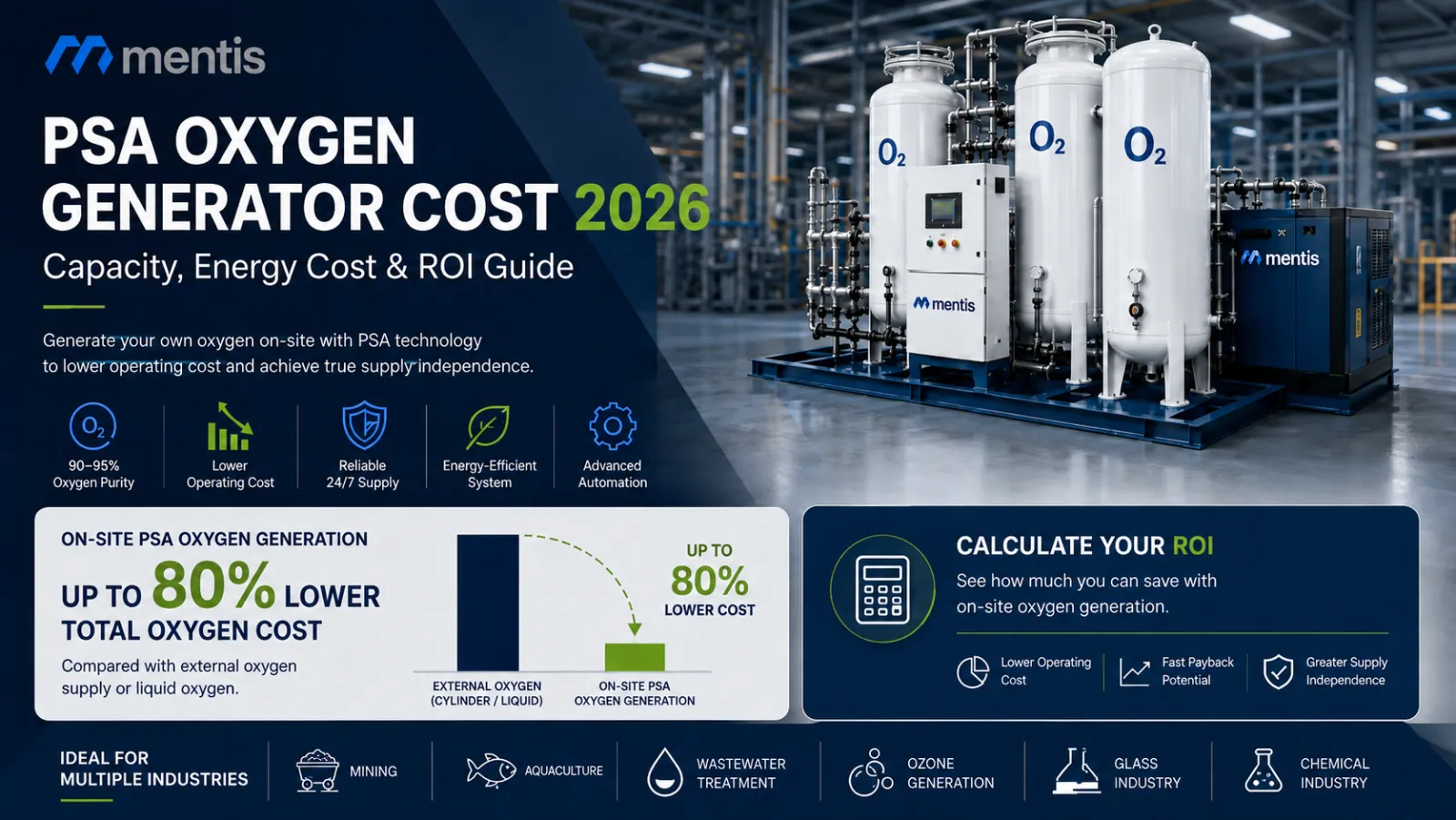
Short answer: there is no single standard price for a PSA oxygen generator.
A PSA system is not simply a catalog product. It is an on-site oxygen generation plant engineered around the actual requirements of the process.
For example, a system operating at:
cannot be directly compared with a plant designed for:
Although both are PSA oxygen systems, their engineering scope and investment levels are completely different.
The right question is therefore not:
“How much does a PSA oxygen generator cost?”
but:
“What capacity do I really need, what will my total investment be, what will one Nm³ of oxygen cost me, and how quickly will the investment pay for itself?”
The most important factors are:
Project-specific requirements may also affect CAPEX, including:
A complete industrial system generally consists of:
Atmospheric Air
→ Air Compressor
→ Air Receiver
→ Dryer
→ Precision Filtration
→ PSA Oxygen Generator
→ Oxygen Receiver
→ Oxygen Purity Analysis
→ Process
Where high-pressure oxygen is required, the system may also include:
→ Oil-Free Oxygen Booster
→ High-Pressure Storage
→ Cylinder Filling Manifold
For this reason, comparing quotations only on the basis of the PSA generator price can be misleading.
One proposal may contain only the PSA unit, while another may include:
A fair comparison must always be based on equivalent technical scope.
Capacity is one of the primary investment drivers.
As oxygen flow increases:
Typical application ranges may be considered as follows:
| PSA Oxygen Capacity | Typical Application Profile |
|---|---|
| 1–10 Nm³/h | Ozone, small process applications, localized oxygen demand |
| 10–30 Nm³/h | Small and medium industrial processes |
| 30–100 Nm³/h | Aquaculture, wastewater, ozone, process oxygen |
| 100–300 Nm³/h | Gold mining, large aquaculture, glass and industrial processes |
| 300+ Nm³/h | Large continuous industrial oxygen consumers |
These values are indicative application ranges, not a product selection table.
Actual sizing should consider:
Average Demand + Peak Demand + Operating Profile + Process Design Margin
Not necessarily.
Oversizing can lead to:
The correct engineering philosophy is not:
“Buy the biggest system.”
It is:
“Select the optimum system capable of safely meeting real process demand.”
Peak consumption must therefore be evaluated together with average demand.
Industrial PSA oxygen systems are generally designed around:
90–95% O₂
depending on the process.
As required purity increases, oxygen recovery and compressed-air demand may change.
In general:
O₂ Purity ↑
→ Oxygen Recovery ↓
→ Compressed Air Demand ↑
→ Energy Consumption ↑
→ Cost per Nm³ O₂ ↑
Therefore, if a process performs safely and effectively at 90–93% O₂, specifying a higher purity without a technical requirement may increase OPEX unnecessarily.
Produce the purity the process actually needs—not the highest purity technically possible.
In most PSA oxygen plants, the largest operating cost is associated with compressed-air generation.
The PLC, analyzer and controls consume relatively little electricity.
The primary energy consumer is:
the air compressor.
For this reason, PSA systems should not be compared only by CAPEX.
A key performance indicator is:
kWh/Nm³ O₂
This parameter shows how much electrical energy is required to produce one normal cubic meter of oxygen.
For example, if a plant consumes:
0.65 kWh/Nm³ O₂
and produces:
100 Nm³/h O₂
the equivalent process energy is approximately:
100 × 0.65 = 65 kW
Actual performance depends on:
The most useful economic metric is:
€/Nm³ O₂
or the relevant local currency per Nm³.
Example:
100 Nm³/h × 8,000 h/year = 800,000 Nm³/year O₂
Assume specific consumption:
0.65 kWh/Nm³
Annual electricity consumption:
800,000 × 0.65 = 520,000 kWh/year
Assume electricity price:
€0.10/kWh
Annual energy cost:
520,000 × €0.10 = €52,000/year
Illustrative maintenance and consumables:
€10,000/year
Total PSA OPEX:
€52,000 + €10,000 = €62,000/year
€62,000 / 800,000 Nm³ = €0.0775/Nm³ O₂
Approximate production cost:
€0.078/Nm³ O₂
These figures are illustrative only. Actual oxygen production cost must be calculated using real project conditions.
Short answer: For high, stable and long-term oxygen consumption, PSA can offer a significant cost advantage compared with externally supplied liquid oxygen.
The comparison should not be based only on the invoice price of LOX.
Depending on consumption, operating hours and local oxygen prices, on-site PSA oxygen generation may provide total oxygen cost savings of up to approximately 80% compared with external oxygen supply in suitable applications.
Actual savings must always be calculated on a project-specific basis.
| Criterion | PSA On-Site Oxygen | Liquid Oxygen – LOX |
|---|---|---|
| Oxygen source | Atmospheric air | External gas plant |
| Production | On-site | External |
| Oxygen purchasing | Can be significantly reduced | Continuous |
| Tanker requirement | None / low | Required |
| Cryogenic storage | Usually not required | Usually required |
| Main OPEX | Electricity + maintenance | Gas + logistics |
| Logistics dependency | Low | High |
| Cost control | Higher | Supplier-dependent |
| Continuous 24/7 demand | Strong application | Applicable |
| Initial CAPEX | Required | Often lower |
| Production control | Facility | Supplier |
ROI evaluates the economic return of the investment.
For PSA projects, a practical metric is the simple payback period.
Annual O₂ Consumption × Delivered O₂ Price
plus:
Electricity + Maintenance + Consumables + Compressor Maintenance
Annual Net Savings = Existing O₂ Cost – PSA OPEX
Payback Period = PSA Investment / Annual Net Savings
| Parameter | Example |
|---|---|
| PSA capacity | 100 Nm³/h |
| Operating time | 8,000 h/year |
| Annual O₂ production | 800,000 Nm³ |
| External oxygen cost | €0.30/Nm³ |
| PSA OPEX | €0.078/Nm³ |
| PSA investment | €300,000 |
External oxygen cost:
800,000 × €0.30 = €240,000/year
PSA OPEX:
800,000 × €0.078 ≈ €62,400/year
Annual savings:
€240,000 – €62,400 = €177,600/year
Simple payback:
€300,000 / €177,600 ≈ 1.69 years
approximately:
20 months
This is an illustrative calculation, not a guaranteed project result.
Higher external oxygen cost improves the potential economics of PSA.
Electricity is one of the largest PSA OPEX components.
A plant operating 8,000 hours per year utilizes its capital investment much more intensively than one operating 2,000 hours.
Unnecessarily high purity may increase energy consumption.
A poorly selected compressor can materially increase total oxygen cost.
Consider a 100 Nm³/h plant.
At:
2,000 h/year
annual production is:
200,000 Nm³
At:
8,000 h/year
annual production becomes:
800,000 Nm³
The same capital equipment therefore generates significantly more useful oxygen.
This is why PSA is particularly attractive for:
Gold leaching and oxidation processes may require significant continuous oxygen demand.
Remote mine sites can particularly benefit from reduced dependence on LOX logistics.
Fish farms can have continuous oxygen demand.
On-site generation can reduce dependence on delivered oxygen and storage.
Pure oxygen can be considered where high oxygen transfer is required.
PSA can provide a controlled and continuous oxygen feed to ozone generators.
Oxygen enrichment and oxy-fuel processes can require significant oxygen volumes.
Applications include melting, cutting and oxidation processes.
The compressor directly influences PSA performance.
It must:
Incorrect selection can result in:
Energy Cost ↑
PSA Performance ↓
Maintenance Cost ↑
Payback Period ↑
The compressor and PSA should therefore be sized as one integrated system.
PSA adsorbents and valves require controlled inlet air quality.
Potential contaminants include:
Proper PSA design should therefore include:
Compressor + Air Receiver + Dryer + Precision Filtration + PSA
A lower-cost but inadequate air treatment system may reduce initial CAPEX while increasing long-term maintenance, adsorbent degradation and unplanned downtime.
Typical advantages:
Can be advantageous for:
A container system may include:
This may increase CAPEX but reduce site installation requirements.
PSA normally produces oxygen at process pressure.
If the application requires:
150–200 bar cylinder filling
an oil-free oxygen booster is required.
The project may then include:
A low-pressure process oxygen system and a high-pressure cylinder filling plant are therefore not comparable investments.
Do not compare only the final price.
| Item | Question to Ask |
|---|---|
| Capacity | At what reference conditions is Nm³/h stated? |
| Purity | What minimum O₂ purity is guaranteed? |
| Pressure | What is the product pressure? |
| Air consumption | Nm³ air / Nm³ O₂? |
| Energy | What is kWh/Nm³ O₂? |
| Compressor | Included? |
| Dryer | Type and capacity? |
| Filtration | What air quality level? |
| Zeolite | Type and quantity? |
| Analyzer | Continuous online measurement? |
| Automation | PLC/HMI included? |
| Remote access | Available? |
| Redundancy | Included for critical equipment? |
| Receivers | Correctly sized? |
| Warranty | Equipment and performance warranty? |
| Commissioning | Included? |
| Training | Operator training included? |
| Service | Local/remote support capability? |
Not always.
Consider:
Lower CAPEX but:
0.80 kWh/Nm³
Higher CAPEX but:
0.65 kWh/Nm³
At 100 Nm³/h and 8,000 h/year:
Annual oxygen production:
800,000 Nm³
Energy difference:
0.15 × 800,000 = 120,000 kWh/year
Over several years, the operating cost difference may exceed the initial price advantage.
Therefore evaluate:
CAPEX + OPEX + TCO
TCO means:
Total Cost of Ownership
For a PSA oxygen plant:
**Initial Investment
For systems expected to operate for 10–15 years, TCO may be far more important than small differences in initial purchase price.
Using these data, engineers can calculate:
**PSA Capacity
Main factors include oxygen capacity, purity, pressure, compressor capacity, operating hours, air treatment, storage, automation and high-pressure options.
Capacity should be based on average demand, peak demand, operating profile and a suitable process design margin.
Most energy consumption comes from the compressor. The correct comparison metric is kWh/Nm³ O₂.
There is no universal payback period. It depends on external oxygen cost, electricity price, annual utilization, maintenance and investment.
For high and continuous consumption, PSA can offer significant savings and, in suitable cases, total oxygen cost advantages of up to approximately 80% compared with external supply.
Yes. Properly engineered industrial PSA systems can be designed for continuous operation.
An air receiver is typically an important element for pressure stabilization and process balancing.
Proper moisture control is essential for long-term PSA performance and adsorbent protection.
It provides buffer storage and helps stabilize product pressure and short-term demand fluctuations.
Yes. Oil-free oxygen boosters can be used where higher pressure or cylinder filling is required.
At Mentis Engineering, we do not evaluate a PSA oxygen project solely by the generator purchase price.
We design the project as an integrated system:
**Compressed Air Generation
Our engineering objective is not to sell the largest generator.
It is to provide:
the right flow + the right purity + the right pressure
at the optimum total cost of ownership.
If you know these four parameters:
1. Hourly oxygen consumption – Nm³/h
2. Current oxygen price – €/Nm³
3. Electricity price – €/kWh
4. Annual operating hours
you can begin an initial comparison between:
Current Annual Oxygen Cost
and:
PSA Annual Energy + Maintenance Cost
From this, you can estimate:
Annual Savings
→ ROI
→ Payback Period
→ 5–10 Year Total Savings
The most important question is not:
“How much does the generator cost?”
The real questions are:
What will one Nm³ of oxygen cost me?
How much energy will I consume annually?
How much can I save compared with delivered oxygen?
How quickly will the investment pay back?
What will my 10-year total cost of ownership be?
For facilities with high and continuous oxygen demand, a properly engineered PSA system can become not only an alternative oxygen source, but a strategic investment in:
cost control, supply security, logistics independence and operational efficiency.
Share your oxygen consumption, current supply cost, required purity and pressure with Mentis Engineering.
Our team can evaluate:
PSA Capacity + Compressor Requirement + Energy Consumption + Cost per Nm³ O₂ + Investment + ROI