
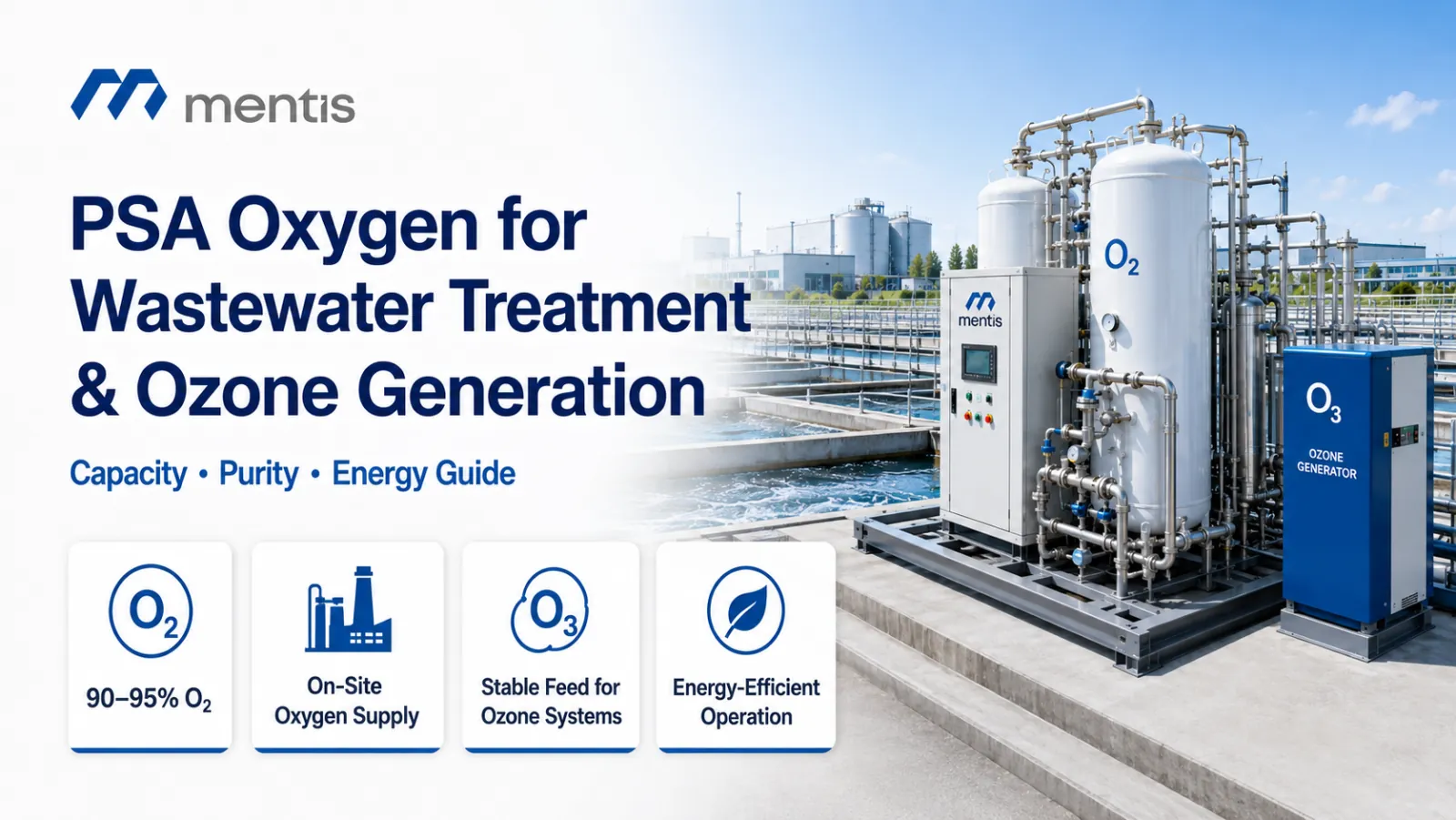
Many biological treatment processes depend on oxygen to support microorganisms responsible for removing organic contaminants.
On-site oxygen can be considered where facilities have:
A PSA oxygen generator produces oxygen from atmospheric air directly at the wastewater treatment plant, providing an on-site source for aeration, oxidation and ozone systems.
Potential applications include:
Atmospheric air contains approximately:
21% O₂
while PSA can typically deliver approximately:
90–95% O₂
for industrial applications.
Higher oxygen concentration allows a greater oxygen mass to be introduced with a smaller gas volume.
However, effective performance depends on the entire transfer system:
PSA Generation + Distribution + Diffuser/Ejector + Tank Hydrodynamics + DO Control
DO – Dissolved Oxygen is the oxygen dissolved in water, generally expressed in:
mg/L
The correct DO setpoint depends on:
There is no universal DO setpoint for every wastewater plant.
Required data may include:
At normal reference conditions:
1 Nm³ O₂ ≈ 1.43 kg
Therefore:
O₂ Flow (Nm³/h)
≈ Required O₂ (kg/h) / 1.43
Example:
143 kg O₂/h
corresponds approximately to:
100 Nm³/h O₂
before transfer efficiency and system margins are considered.
Not all oxygen produced by the generator is transferred into the liquid.
Transfer efficiency depends on:
Therefore:
PSA Output ≠ Oxygen Actually Absorbed by the Water
The generator and transfer system must be sized together.
Ozone is:
O₃
and is produced from oxygen-containing feed gas.
Industrial ozone generators may use:
Oxygen-fed ozone systems can support higher ozone concentrations when designed accordingly.
PSA therefore provides an attractive on-site oxygen feed source for ozone generators.
Atmospheric Air
→ Compressor
→ Drying
→ Precision Filtration
→ PSA Oxygen Generator
→ O₂ Buffer Tank
→ Purity Analysis
→ Ozone Generator
→ Ozone Contactor / Process
Key feed parameters include:
Many industrial applications may use PSA oxygen around:
90–95% O₂
However, the final specification must follow the ozone generator manufacturer's inlet-gas requirements.
Check:
Ozone generators generally require very dry feed gas.
Excess moisture can:
For ozone applications:
O₂ Purity + Dew Point + Pressure + Flow
must be specified together.
Ozone generator capacity is generally stated as:
g/h O₃
or:
kg/h O₃
The required oxygen feed depends on ozone concentration.
Simplified:
O₂ Feed Mass Flow
≈ O₃ Production / O₃ Mass Fraction
Example:
For:
1 kg/h O₃
at approximately:
10 wt% ozone
total feed/product gas flow is in the order of:
10 kg/h
or roughly:
7 Nm³/h oxygen equivalent
before generator-specific corrections.
Final sizing must always follow the ozone generator specification.
Cylinders can be practical for small intermittent systems.
For continuous demand, they may create:
PSA converts the supply model primarily to:
Atmospheric Air + Electricity + Maintenance
| Criterion | PSA On-Site O₂ | LOX |
|---|---|---|
| Oxygen source | Atmospheric air | External supplier |
| Production | On-site | External |
| Tanker dependency | Very low | High |
| Cryogenic storage | Usually unnecessary | Required |
| Main OPEX | Energy + maintenance | Gas + logistics |
| Continuous operation | Strong candidate | Suitable |
| Supply control | Facility | Supplier |
| Scalability | Modular | Requires greater delivery/storage |
The primary electrical consumer is usually:
the air compressor.
Compare systems using:
kWh/Nm³ O₂
Annual energy cost:
Average kW × Annual Operating Hours × Electricity Price
Advanced wastewater installations can link:
DO Sensor → PLC → Oxygen Demand → PSA / Compressor Control
This allows oxygen generation to follow real process load rather than continuously operating at maximum output.
Potential benefits include:
An O₂ receiver can:
For critical wastewater plants, configurations may include:
depending on process availability requirements.
Yes. PSA oxygen can supply oxygen-enriched biological and oxidation processes when integrated with an appropriate transfer system.
The actual kg O₂/h requirement, transfer efficiency and peak process load must be calculated.
Many industrial ozone generators can operate with oxygen-enriched feed gas. Final purity, dew point and pressure requirements must follow the manufacturer's specifications.
Approximately 90–95% O₂ can be suitable for many applications, subject to equipment requirements.
Yes. Industrial systems can be designed for continuous duty and redundancy.
It can be attractive for high and continuous oxygen consumption. The correct decision should be based on project-specific TCO and ROI.
Mentis Engineering evaluates the complete oxygen system:
**Air Compressor
Our engineering team can calculate:
PSA Capacity + Compressor + Energy Consumption + O₂ Cost per Nm³ + OPEX + TCO + ROI
Mentis Engineering – On-Site Oxygen Generation for Water & Ozone Applications